George Mason, the Clause He Refused to Compromise, and the Bill of Rights He Forced Into Existence
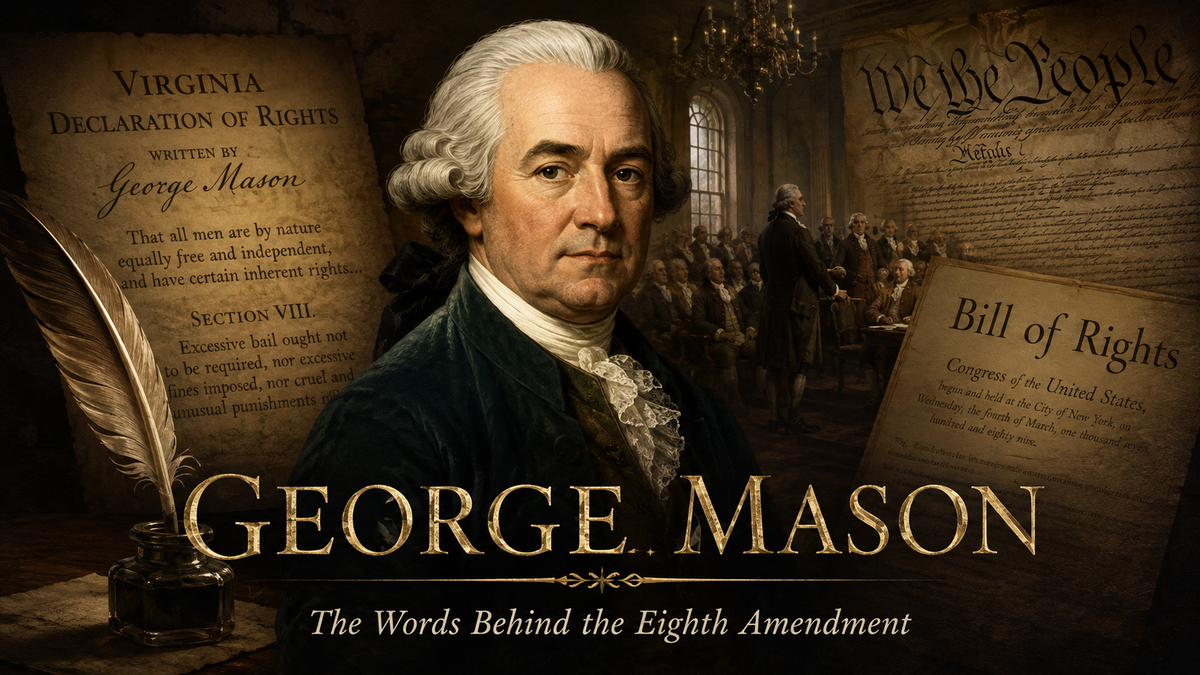
How the Author of the Excessive Bail Protection Still Anchors the Bail Profession Today
This is the fourth installment in a series exploring American history through the lens of accountability — how the Founders constructed systems that balanced liberty with genuine responsibility, and why those hard-won lessons continue to shape the work of public safety in our own time.
In the first piece, John Adams stood in the courtroom at great personal risk, insisting that the rule of law must apply even to those the public had already condemned. In the second, Thomas Paine exposed how systems that diffuse responsibility inevitably fail, and demanded structures that actually incentivize compliance and consequence. In the third, Benjamin Franklin showed that even the best-designed mechanisms of accountability erode without the personal virtue of the people who operate them. Now we turn to George Mason, and his place in this series is different from the other three. Adams, Paine, and Franklin gave us the character and the architecture of accountability. Mason gave us the actual words. He is the only Founder in this series whose connection to bail is not thematic. It is literal. He wrote the sentence.
In May of 1776, the Fifth Virginia Convention tasked George Mason with drafting a declaration of rights for the new state government forming in Williamsburg. Mason worked quickly, drawing on the Magna Carta and on English common law traditions that stretched back centuries, and produced a document that would outlive the moment it was written for. The Virginia Declaration of Rights was adopted on June 12, 1776 — three weeks before Jefferson finished the Declaration of Independence, and Jefferson leaned on Mason's language as he wrote it. Article One alone announced that all men possess inherent rights to “the enjoyment of life and liberty, with the means of acquiring and possessing property, and pursuing and obtaining happiness and safety.” But it is Article Nine that built the profession we practice today. It reads, in full: “That excessive bail ought not to be required, nor excessive fines imposed, nor cruel and unusual punishments inflicted.”
Eleven years later, when the delegates in Philadelphia drafted the language that would become the Eighth Amendment, they did not improve on Mason's sentence. They barely touched it. “Excessive bail shall not be required, nor excessive fines imposed, nor cruel and unusual punishments inflicted.” The word order changes. Nothing else does. Every bail agent working a courthouse in America today is operating inside a constitutional protection that one man in Virginia wrote almost word-for-word more than two centuries ago, and that every other state later copied into its own constitution.
Mason earned the authority to write that sentence, and he refused to let it go unfinished. When the Constitutional Convention closed its work in September of 1787, Mason stood and pointed out what the document did not contain: no declaration of rights. He proposed one. The other delegates, exhausted after months of negotiation and eager to adjourn, voted it down without a single state in favor. Mason would not sign what he had helped build. He was one of only three delegates at the Convention who refused, alongside Elbridge Gerry of Massachusetts and Edmund Randolph of Virginia, and he left Philadelphia to write “Objections to this Constitution of Government,” a pamphlet whose opening sentence became the rallying line of the entire Anti-Federalist movement: “There is no Declaration of Rights.”
The cost to Mason was real and immediate. He returned home to find himself accused of vanity and failing judgment by men who had called him a friend for decades, including George Washington, whose friendship with Mason did not survive the disagreement. A crowd in Alexandria greeted him not with thanks but with open hostility, and he was warned to leave town within the hour for his own safety. Mason held his position anyway. He told the Virginia House of Delegates that he had weighed every article of the Constitution “deeply and maturely” and could not approve it as written, and that he would rather lose his hand than sign a document that left the individual unprotected against the government being created. He was not being difficult for its own sake. He had already written the fix. He simply refused to accept a Constitution that left it out.
He won. Anti-Federalist pressure built on the argument Mason supplied forced the First Congress to draft a bill of rights as the price of ratification in several states, and James Madison, who had opposed Mason's proposal at the Convention two years earlier, became the one who carried it through Congress. The Eighth Amendment's bail clause is Mason's Virginia language, virtually unchanged, finally attached to the federal Constitution he had refused to sign.
That is the inheritance every bail agent works inside. The excessive bail clause is not a technicality that happens to touch our profession. It is the reason our profession is constitutionally possible. Mason understood something that gets lost in every modern debate over pretrial release: a right that exists only on paper, with no mechanism to make it real, is not a right at all. The clause tells the government it cannot price a person out of their liberty before conviction. Surety bail is one of the mechanisms that makes that promise operational — a defendant, a bondsman, and a financial and personal stake in the outcome, standing where an unenforceable guarantee would otherwise stand alone. When courts stretch bail schedules past what a defendant can reasonably pay, or when reform advocates argue that any bail at all is inherently excessive because some cannot afford it, they are not raising a new argument. They are re-litigating Mason's clause, usually without citing it.
Mason's other great fight belongs here too, and it would be dishonest to leave it out. He refused to sign the Constitution in part because it protected the slave trade, a position that put him at odds with his own economic interests as a Virginia planter and that he did not soften to make peace with his fellow delegates. Mason was not a man who calculated which principles were convenient to hold. He held the ones he had reasoned his way to, regardless of what they cost him socially or personally, and that is the same trait that shows up in every bail agent who enforces the terms of a bond a defendant's family does not want enforced, or who tracks down a client at 2 a.m. because the alternative is a forfeited bond and a victim still waiting for the case to move forward. Accountability that only holds when it is convenient is not accountability. Mason built his entire legacy on refusing that shortcut.
The lesson of this series has been that the Founders did not design accountability as an abstraction. Adams gave it courage in the courtroom. Paine gave it architecture. Franklin gave it the personal virtue that keeps any system honest. Mason gave it a sentence that has now protected pretrial liberty in America for two hundred and fifty years, and he was willing to be the loneliest man in Philadelphia to make sure that sentence was not optional. Bail agents show up every day to make good on it. That is not a coincidence of history. It is the whole point of writing it down in the first place.
About the Author
Mike Morrison is the 2026 PBUS National Bail Agent of the Year, President of the Mississippi Bail Agents Association, and a nationally recognized bail educator, speaker, and criminal justice commentator. With more than 35 years of hands-on experience as a licensed Professional Bail Agent and owner of Mike Morrison Bail Bonding Company in Hattiesburg, Mississippi, he brings a practical, real-world perspective to discussions involving bail, criminal justice, constitutional rights, public safety, government accountability, technology, and public policy.
Morrison is recognized as a bail trainer by the Mississippi Judicial College and has been invited to present before judges, justice court clerks, prosecutors, bail professionals, and other criminal justice stakeholders, including as a guest speaker for the Mississippi Attorney General’s Office. He also leads professional education and ethics programs for bail agents across the country through the Master Class Bail Agent Series and other national training initiatives.
He has published nearly 200 articles examining the institutions, policies, and decisions that affect working Americans. His writing is grounded in decades spent inside courtrooms, jails, communities, and the criminal justice system, and his commentary has reached more than one million views across social media in 2026.
Independent, plain-spoken, and focused on accountability, Morrison writes and speaks about the intersection of government, liberty, public safety, professional responsibility, and the real-world consequences of public policy in Mississippi and across the nation.
© 2026 Mike Morrison. All rights reserved.