Before the Eighth Amendment: When Bail Became a Rule of Law
How the Statute of Westminster I began limiting government discretion over pretrial liberty more than five centuries before the Bill of Rights
Long before George Mason, the Virginia Declaration of Rights, or the Eighth Amendment, English law was already struggling with a question that remains familiar today: how much power should government officials have over the liberty of an accused person before trial? In medieval England, local sheriffs exercised substantial authority over detention and release while royal justices traveled from county to county rather than sitting continuously in every community. That system created obvious opportunities for unequal treatment and abuse. An accused person could remain confined while awaiting the arrival of the court, and the official controlling access to release held enormous practical power over that person’s freedom.
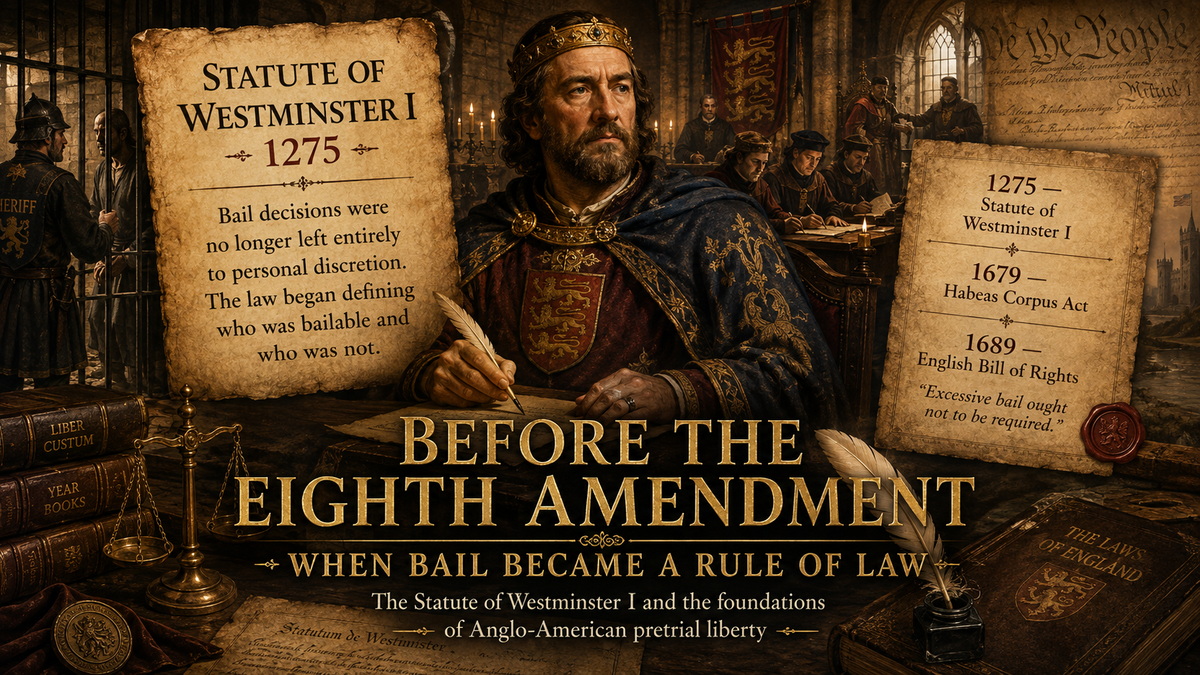
The Statute of Westminster I, enacted in 1275 during the reign of Edward I, was an important attempt to replace that discretion with law. It set out categories of offenses that were bailable and those that were not, establishing statutory rules governing who could be released rather than leaving the decision entirely to local authority. The Constitution Annotated describes Westminster I as the basic English authority on bail, as supplemented by later statutes, for roughly five and a half centuries. Its significance was therefore larger than any individual list of offenses: government officials were being told that pretrial detention and release were matters governed by legal standards, not merely personal judgment.
But Westminster I did not solve every problem. Determining that an accused person was legally eligible for bail did not necessarily guarantee meaningful release. The amount or conditions required could still become another way of keeping someone confined. That distinction eventually became critical. English law had begun by addressing who was entitled to bail, but it still needed mechanisms to challenge unlawful detention and protections against setting bail so high that the right became meaningless. The history of bail therefore developed in stages rather than through a single statute.
This historical progression unfolded in three clear steps: the Statute of Westminster I established legal rules governing bail eligibility; the Habeas Corpus Act of 1679 strengthened the procedure by which detention could be challenged; and the English Bill of Rights of 1689 declared that excessive bail ought not to be required. Each development addressed a different weakness in the system. Westminster restricted arbitrary decisions over who could be released. Habeas corpus provided a means of testing detention. The prohibition against excessive bail prevented government from granting release in theory while making it impossible in practice through unreasonable financial conditions.
That legal inheritance traveled directly into American constitutional development. George Mason carried the language against excessive bail into the Virginia Declaration of Rights in 1776, and the protection later appeared in the Eighth Amendment: “Excessive bail shall not be required.” The American Constitution did not guarantee bail in every case, and the Supreme Court has made clear that the Excessive Bail Clause does not require release for every accused person. What it does require is that government may not use bail excessively in relation to the legitimate purpose being served.
The importance of Westminster I is therefore not that medieval England created the system of professional surety bail we recognize today. It did not. Its importance is that, as early as 1275, lawmakers were already confronting the danger of allowing government officials unchecked discretion over the freedom of people who had not yet been convicted. That principle survived centuries of legal development, passed through habeas corpus and the English prohibition against excessive bail, crossed the Atlantic, and ultimately became part of American constitutional law. The institutions have changed; the central question has not—when government takes control of a person’s liberty before trial, that power must be governed by law.
ABOUT: Mike Morrison has spent 35 years working as a Professional Bail Agent in Mississippi, building a career grounded in firsthand experience with defendants, families, courts, law enforcement and the day-to-day realities of the criminal justice system. His commitment to education has led to recognition as a bail trainer by the Mississippi Judicial College and invitations to speak before judges, justice court clerks, prosecutors and other criminal justice professionals, including as an invited guest speaker for the Mississippi Attorney General’s Office.
For nearly two years, Morrison has worked to develop the Master Class Bail Agent Series with one goal: to elevate the knowledge, professionalism and value of the modern Bail Agent. The series draws from decades of practical experience and focuses on giving Bail Agents a deeper understanding of the laws, procedures and responsibilities that allow them to better serve their clients, their courts and their profession.