Bail Versus Pretrial: Why Bail Wins Every Time
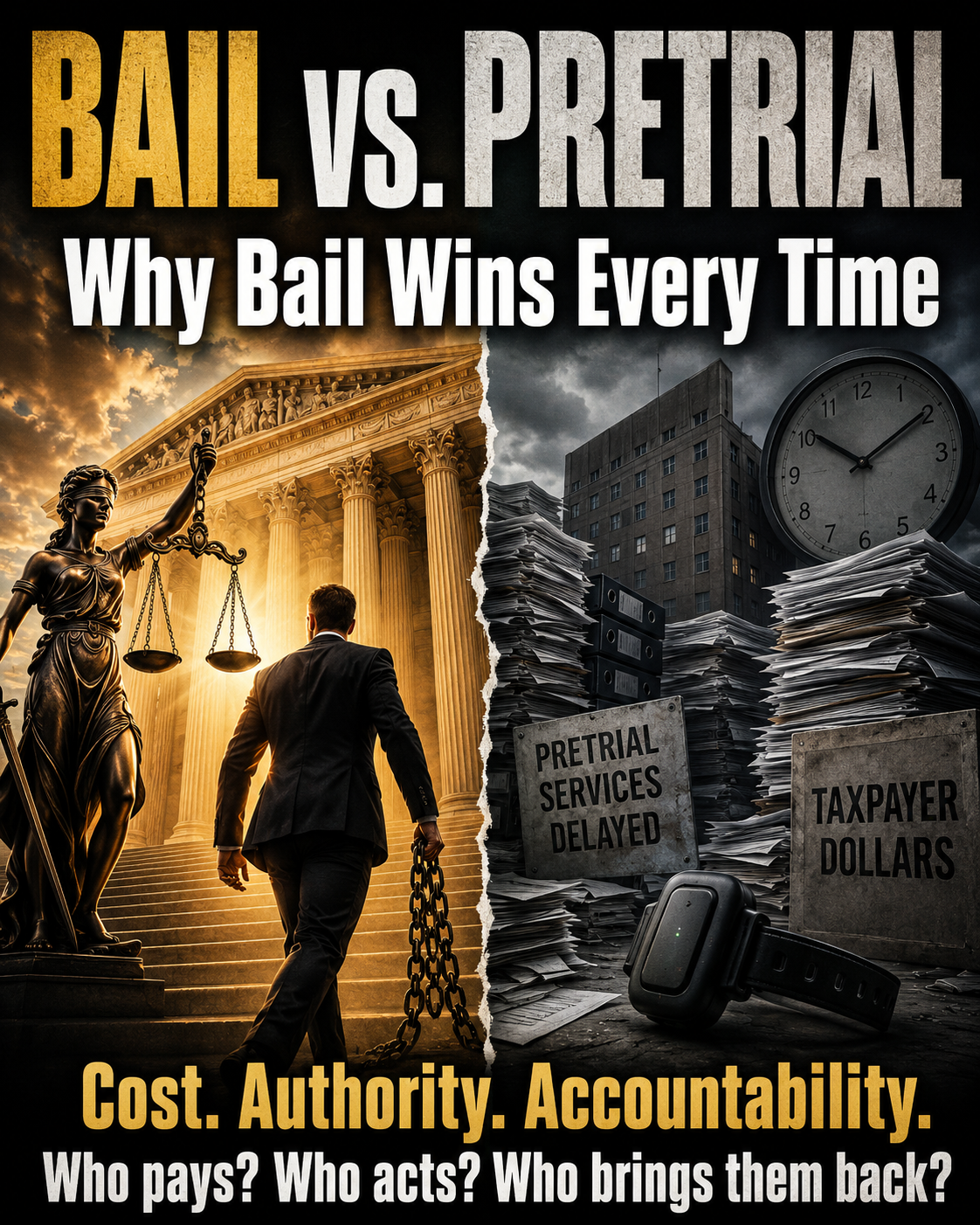
"Follow the Money, the Authority, and the Accountability — and See Which System Actually Works"
The difference between government pretrial services and professional surety bail becomes much easier to understand when we stop arguing slogans and start looking at how the two systems actually operate. Both are supposed to help ensure that defendants released before trial return to court and comply with the conditions imposed upon them. But they do not accomplish that mission in the same way, they do not place responsibility in the same place, and they certainly do not place the financial burden in the same place. When we compare who pays, who has the authority to act, who is responsible when a defendant disappears, and what must happen before that defendant can be returned to custody, professional bail deserves a much more serious examination than the Anti-Surety Movement has been willing to give it.
Start with the cost. Government pretrial services is not free release. It is taxpayer-funded supervision. One of the most established programs in the country, the federal Pretrial Services Agency for the District of Columbia, has an FY2026 enacted annual operating budget of $83.475 million. PSA’s FY2026 budget reflects 346 full-time-equivalent positions, while the agency identifies its authorized staffing level as 371 FTE. Federal law authorizes pretrial services to supervise defendants, arrange treatment and monitoring services, contract with providers, report violations and maintain the administrative structure necessary to operate the program. There may be legitimate reasons for some of those expenditures, but we should at least call the system what it is: a government agency financed by taxpayers to supervise defendants awaiting trial.
Professional surety bail changes that financial equation. The private surety assumes a financial obligation guaranteeing the defendant’s appearance, and the bail agent has a direct economic reason to know where that defendant is and to respond when the obligation is placed in jeopardy. Mississippi law goes even further when a defendant is incarcerated outside the jurisdiction. Section 99-5-27 places responsibility for returning that defendant on the bail agent. The agent may personally return the defendant at no cost to the county, and when another jurisdiction will release the defendant only to law enforcement, the agent is responsible for reimbursing the county for the reasonable cost of that return. One system requires taxpayers to finance the supervision infrastructure. The other places substantial financial risk and recovery responsibility on a private surety.
Then we get to authority, and this is where the comparison becomes even more interesting. Federal pretrial services officers are authorized to supervise defendants, identify violations, inform the court and prosecutor, and recommend that release conditions be modified. If revocation becomes necessary, federal law provides a judicial process through which an arrest warrant may be issued and the defendant brought before the court. The pretrial officer is an important part of that process, but the officer does not independently acquire custody of a defendant simply because a condition of release has been violated.
Compare that structure with professional bail in Mississippi. Section 99-5-27 expressly provides that a bail agent may arrest and transport the agent’s principal and may authorize another person to do so for purposes of surrender. The statute also establishes a procedure for a bail agent to protect the bond when the principal is incarcerated in another jurisdiction. That authority is specific to the bail relationship; it is not a general police power, and recovery laws vary from state to state. But the distinction is significant. The professional bail agent is not merely observing the defendant and forwarding information to another government agency. Mississippi law gives the surety a direct legal mechanism to take responsibility for its own principal.
That difference becomes especially important after a failure to appear or serious violation. Government pretrial supervision operates through an institutional process. The violation must be detected, evaluated and reported, and the appropriate judicial or law-enforcement response must then follow. The District of Columbia Pretrial Services Agency, for example, uses graduated responses to noncompliance and has described a risk-based process intended to identify an appropriate response within one to three business days depending upon the defendant’s circumstances and risk level. That may be a reasonable way for a government agency to operate, but it illustrates the difference between supervising a defendant and possessing direct authority to recover one.
A surety operates under a different legal incentive. Once the bail agent learns that the principal has failed to appear or that surrender has otherwise become necessary, Mississippi law already provides authority to locate, arrest and surrender that principal. Communication still matters. Under Mississippi’s forfeiture statute, a bench warrant and judgment nisi are to issue following the ordered nonappearance, while the clerk has up to ten working days to serve the required forfeiture documents upon the surety. A bail agent cannot react to information that has not been received, which is precisely why prompt communication between courts, clerks, law enforcement and sureties matters. But once the information reaches the bail agent, the legal authority to recover the principal does not have to be created through another administrative process.
Interstate recovery exposes another difference that is often misunderstood. A bail agent does not perform governmental “extradition.” Extradition is the formal sovereign process used to return fugitives between jurisdictions. Under federal law, interstate extradition may involve a formal demand from one state to another, supporting charging documents, arrest in the asylum state, notification to the demanding state and delivery of the fugitive to an authorized agent. The government ultimately bears the costs associated with that governmental process.
Surety recovery is different. The United States Supreme Court recognized the historic custody relationship between bail and principal in Taylor v. Taintor, although modern recovery authority is now governed heavily by individual state statutes and regulations. No responsible bail agent should claim that a bondsman can simply cross a state line and ignore another state’s laws. But Mississippi law clearly recognizes the bail agent’s authority to arrest and transport a principal and places responsibility for returning an incarcerated out-of-jurisdiction principal upon the surety under the statutory procedure. That private recovery mechanism is something a government pretrial supervision agency does not itself provide.
Performance must also be part of this discussion. A peer-reviewed 2017 study examined 29,416 defendants booked into the Dallas County jail and compared commercial bail bonds with cash bonds, attorney bonds and pretrial-services releases. Using propensity-score methods intended to compare similarly situated defendants, the researchers found commercial-bond defendants significantly less likely to fail to appear than defendants released through the other mechanisms examined. The largest estimated difference was between commercial bonds and pretrial-services bonds, with the study reporting a difference ranging from 0.12 to 0.15, or approximately 12 to 15 percentage points. The researchers also disclosed an important limitation: Dallas County’s pretrial-services operation during the study period was understaffed and did not provide the level of supervision available in some more developed programs. That limitation should be acknowledged, but it does not erase the study’s result.
And that brings us to the question policymakers should be asking. If government wants to replace professional surety bail with taxpayer-funded pretrial supervision, the comparison cannot stop when the defendant walks out of jail. Follow that defendant through the entire process. Calculate the personnel, technology, monitoring, treatment, contracts and administration necessary to operate the government alternative. Then examine what happens when the defendant stops reporting, violates a condition, fails to appear or leaves the jurisdiction.
Professional surety bail places financial responsibility, legal authority and a private incentive to recover the defendant in the hands of someone whose own money and professional obligation are tied directly to that defendant’s appearance. Government pretrial services places supervision within a publicly funded agency and depends upon the larger criminal justice system when enforcement becomes necessary.
That is why bail wins this comparison.
Not because every defendant released on bail will appear. Some will fail.
Not because every pretrial program will fail. Some produce respectable results.
Bail wins because when the defendant does fail, someone other than the taxpayer has money at risk, someone other than a government agency has a direct financial incentive to locate that defendant, and in Mississippi that person already has statutory authority to bring the principal back into custody.
Before professional surety bail is dismissed as an outdated system that government should replace, taxpayers deserve an answer to a very simple question:
Why should the public pay government to assume a responsibility that a private surety is already willing to accept?
About the Author
Mike Morrison is the 2026 PBUS National Bail Agent of the Year, President of the Mississippi Bail Agents Association, and a nationally recognized bail educator, speaker, and criminal justice commentator. With more than 35 years of hands-on experience as a licensed Professional Bail Agent and owner of Mike Morrison Bail Bonding Company in Hattiesburg, Mississippi, he brings a practical, real-world perspective to discussions involving bail, criminal justice, constitutional rights, public safety, government accountability, technology, and public policy.
Morrison is recognized as a bail trainer by the Mississippi Judicial College and has been invited to present before judges, justice court clerks, prosecutors, bail professionals, and other criminal justice stakeholders, including as a guest speaker for the Mississippi Attorney General’s Office. He also leads professional education and ethics programs for bail agents across the country through the Master Class Bail Agent Series and other national training initiatives.
He has published nearly 200 articles examining the institutions, policies, and decisions that affect working Americans. His writing is grounded in decades spent inside courtrooms, jails, communities, and the criminal justice system, and his commentary has reached more than one million views across social media in 2026.
Independent, plain-spoken, and focused on accountability, Morrison writes and speaks about the intersection of government, liberty, public safety, professional responsibility, and the real-world consequences of public policy in Mississippi and across the nation.
© 2026 Mike Morrison. All rights reserved.