What’s Actually in the Vial?
What’s Actually in the Vial?
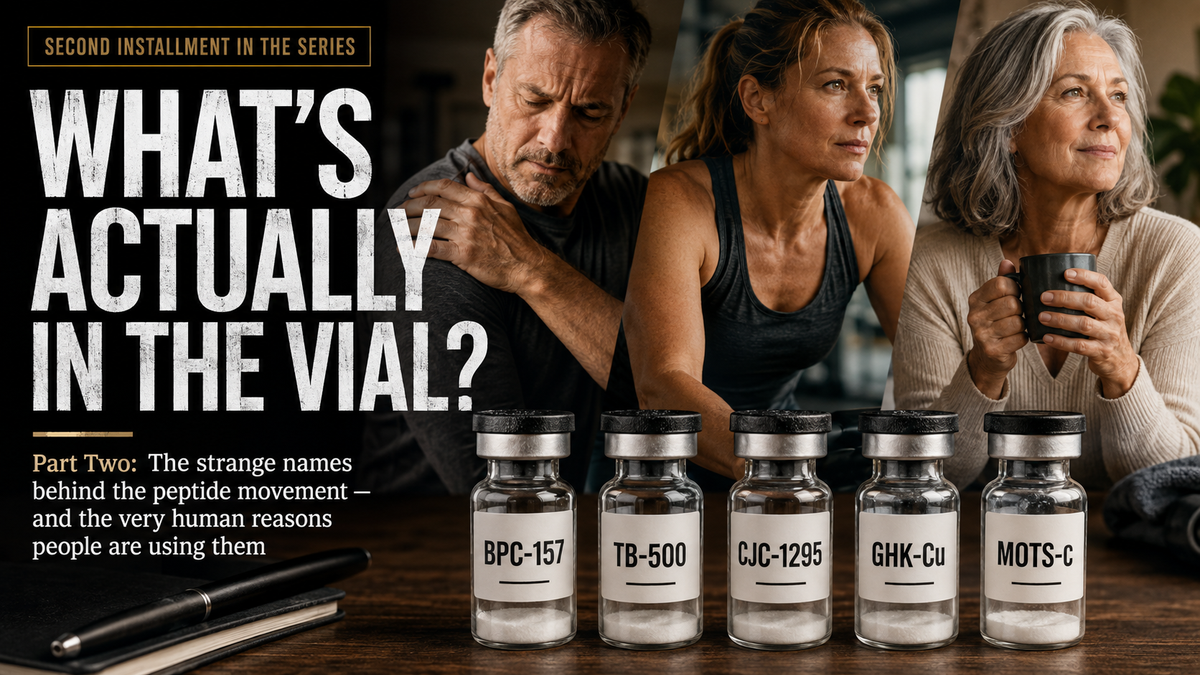
Part Two: The strange names behind the peptide movement — and the very human reasons people are using them
In the first discussion, I wrote about Americans who have stopped waiting for permission when it comes to peptides, weight loss, recovery, and aging. They are listening to friends, following people they trust, reading on their own, and making decisions long before the traditional medical system is ready to tell them whether those choices are acceptable.
That leaves one obvious question for anyone standing outside this world looking in: what are people actually taking?
The first problem is the names. BPC-157. TB-500. CJC-1295. GHK-Cu. MOTS-c. PT-141. To the average person, they sound like industrial part numbers, not things people discuss over dinner. But behind every one of those codes is a very ordinary reason somebody went looking for it in the first place.
From Aching Joints to Physical Recovery
Take BPC-157. BPC stands for Body Protection Compound, and 157 is simply part of the original research designation. People hear about it because it has become closely associated with tissue recovery—particularly stubborn problems involving tendons, ligaments, muscles, and joints.
A man with a shoulder that has bothered him for three years isn't sitting at home studying peptide chemistry. He is wondering whether he can reach above his head without pain again. When someone he knows mentions BPC-157, that is often how the door opens.
TB-500 tends to enter the same conversation. The "500" is another identifying label, not a dosage. People look into it for the same fundamental reasons: healing and connective tissue repair. While the underlying science differs between the two compounds, the person looking at them usually has one simple question in mind: Can I get back to doing something my body is no longer letting me do comfortably?
Confronting the Biological Clock
Then the conversation shifts from injury to aging. Someone may not be hurt at all; he is simply sixty-five years old and notices that his body no longer responds the way it once did. He can still exercise, but recovery takes twice as long. Muscle is harder to maintain. Body composition shifts. Energy drops.
That is where names like CJC-1295, ipamorelin, and sermorelin enter the picture—compounds tied to the body’s own growth-hormone signaling pathways. Again, the person using them isn't trying to master endocrinology. He is trying to understand why he feels so different at sixty-five than he did at forty-five, and whether some of that decline can be actively managed rather than passively accepted.
GHK-Cu moves into another part of that same conversation. "GHK" represents a string of three amino acids, while "Cu" is the chemical symbol for copper—which is why most people simply call it the copper peptide. Interest here centers on skin, hair, and the visible signs of aging. That shouldn't surprise anyone. Human beings have spent money for generations trying to preserve their hair, improve their skin, and look younger. Peptides simply gave them another venue to explore.
PT-141 draws attention for a different reason entirely: sexual response. Aging changes sexual function, and men and women have spent billions of dollars over the decades seeking reliable solutions. The peptide market has simply expanded the list of options people are willing to ask about.
MOTS-c comes up in discussions about metabolism, cellular energy, and stamina. It is a peptide produced from genetic material within the mitochondria—the powerhouses inside our cells. For people interested in endurance or simply feeling less worn down as the years stack up, MOTS-c has caught their attention. The underlying science gets complex fast, but the motivation isn't technical at all: people want to know if feeling constantly drained is an inevitable tax of aging, or something they can influence.
The Breakthrough That Changed the Rules
And then there are the names almost everybody already knows: Ozempic. Wegovy. Mounjaro. Zepbound.
Semaglutide and tirzepatide changed the entire public conversation because millions of Americans didn't need to read peer-reviewed research papers to understand the results. They watched friends lose forty pounds. They watched relatives lose sixty. They saw people who had struggled with their weight for decades experience a completely different relationship with hunger and satiety.
That mattered.
Once ordinary people saw that the body’s internal signaling systems could be influenced strongly enough to produce visible, life-changing results, it was inevitable they would start asking what else might be possible.
- Could an old joint injury heal better?
- Could muscle mass be preserved longer?
- Could skin age differently?
- Could sexual vitality be maintained?
- Could daily energy be restored?
- Could physical decline eventually become something we manage rather than endure?
Those are the human questions sitting underneath the peptide movement.
Peer Proof vs. Clinical Trials
Some of these compounds have extensive human research behind them; others remain experimental. There is also a world of difference between a prescription product manufactured under clinical standards and a vial bought from an unverified vendor online. Those distinctions matter immensely, and anyone pretending otherwise isn't being serious about safety.
But those distinctions don't explain why this market is exploding. People explain that.
 Michael D. Morrison
ABOUT: Mike Morrison is a writer, speaker and longtime practitioner whose work focuses on public safety, accountability, personal responsibility and the changing relationship between Americans and the institutions they have traditionally relied upon.
Since October 2025, Morrison has personally lost 70 pounds, dropping from 240 pounds to 170 through disciplined diet, consistent gym training, hard work and the use of peptides. That experience led him to look much more closely at the rapidly expanding peptide movement, the results people are reporting, the science behind the compounds and the reasons ordinary Americans are increasingly taking a more active role in decisions about their own health.
His current peptide series examines that movement from the perspective of a consumer and writer, not a physician, with an emphasis on separating documented facts from marketing claims while keeping the discussion understandable to people outside the medical community.
Across nearly 200 published discussions, Morrison has built his writing around firsthand experience, independent research and a simple question: what is actually happening in the lives of the people affected by the systems, policies and technologies we are being asked to trust?