Americans Stopped Waiting for Permission
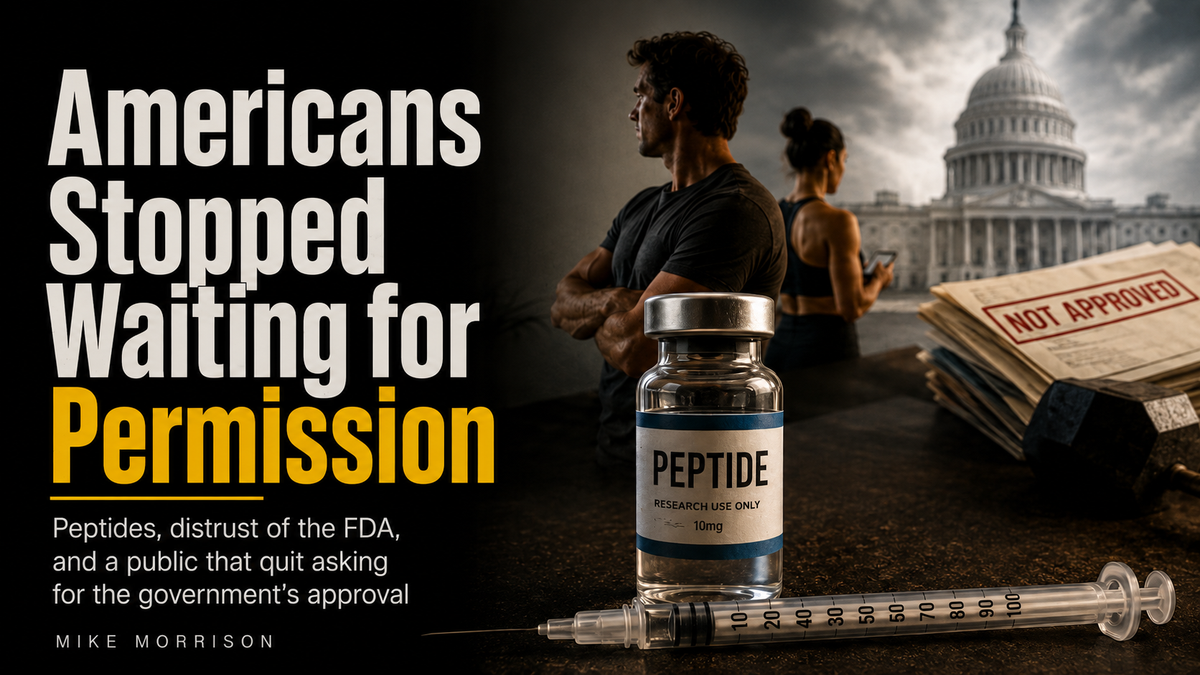
Peptides, distrust of the FDA, and a public that quit asking for the government's approval
Millions of Americans are injecting themselves with peptides right now. Not because a doctor prescribed it. Not because insurance covered it. Because they went looking for something that worked, found it, and decided they didn't need permission to use it.
A peptide is a small chain of amino acids — the same building blocks the body already uses to repair tissue, regulate hormones, and control metabolism. Insulin is a peptide. So is Ozempic. The ones spreading through gyms and living rooms across the country work the same way, just without a prescription pad attached. People are using them for weight loss. For faster recovery from injury. For better skin. For aging slower. That's the whole pitch, and it doesn't require a chemistry degree to understand it.
This isn't a fringe habit anymore. Podcasters talk about it. Trainers recommend it. Neighbors compare results the way they used to compare protein powder. Nobody using these products cares what the compound is called. They care that a friend lost twenty pounds, healed a torn shoulder in half the time, or just feels better than they did last year — for a fraction of what the pharmaceutical version would have cost.
Here's the part worth sitting with: none of this happened because Americans stopped caring about their health. It happened because they stopped trusting the people who were supposed to manage it for them.
COVID did that. Guidance changed by the month — masks, transmission, vaccines — and officials who sounded certain in April walked it back by June. "Follow the science" turned into a moving target instead of a fixed one. Trust doesn't survive that. Once people decided the experts didn't always know, and didn't always say so when they didn't, they stopped waiting for a green light on the next health decision. Peptides are where that instinct landed.
The FDA answered the growing demand for these compounds with a ban in 2023, blocking compounding pharmacies from making them. It didn't work. Demand didn't drop — it moved overseas, to unregulated sellers shipping product with no way for the buyer to know what's actually in the vial. That's the real failure here. The agency built a wall, and the public went around it. A regulator that can't stop the behavior it's trying to stop isn't protecting anyone. It's just pushing the risk somewhere it can't see it.
Cost is the other half of it, and it's not a small half. The pharmaceutical path to the same results — weight loss, hormone therapy, injury recovery — runs through years of clinical trials, a patent, and a price built to pay for all of it. Peptides skip most of that. Many of them can't even be patented, so the drug companies that would normally fund the research have no financial reason to. That's not a conspiracy. It's just where the incentives sit. And it leaves a gap between what medicine could offer and what it actually delivers — a gap Americans are filling themselves, for a fraction of the price, because nobody built them a legitimate way to do it inside the system.
The FDA is starting to notice. Under pressure in 2026, the agency began reversing part of its own ban, moving several of these peptides back onto the approved compounding list. That's not the science suddenly catching up. That's the agency admitting the ban didn't work — that people were getting these compounds one way or another, and a regulated domestic supply beats an unregulated overseas one. The admission matters more than the policy change.
ABOUT: Mike Morrison is a writer, speaker and longtime practitioner whose work focuses on public safety, accountability, personal responsibility and the changing relationship between Americans and the institutions they have traditionally relied upon.
Since October 2025, Morrison has personally lost 70 pounds, dropping from 240 pounds to 170 through disciplined diet, consistent gym training, hard work and the use of peptides. That experience led him to look much more closely at the rapidly expanding peptide movement, the results people are reporting, the science behind the compounds and the reasons ordinary Americans are increasingly taking a more active role in decisions about their own health.
His current peptide series examines that movement from the perspective of a consumer and writer, not a physician, with an emphasis on separating documented facts from marketing claims while keeping the discussion understandable to people outside the medical community.
Across nearly 200 published discussions, Morrison has built his writing around firsthand experience, independent research and a simple question: what is actually happening in the lives of the people affected by the systems, policies and technologies we are being asked to trust?