What Happens When the Results Come First?

Part Three: When personal experience begins to outrun traditional medicine
Something has changed in the way people talk about their health, and you can hear it in ordinary conversations. Someone does not sit down at dinner and announce that he has been studying metabolic signaling or peptide research. He says he has lost fifty pounds and does not think about food all day anymore. Someone else says the shoulder that has bothered him for years finally feels better. Another person says she has more energy, is back in the gym, or simply feels better than she did a year ago. The conversation almost always moves to the same place from there: what are you taking?
With some of these medications, the results people are talking about are no longer a matter of opinion. In one of the major semaglutide studies, people lost an average of 14.9 percent of their starting body weight over 68 weeks. Put that into normal language and a person starting at 200 pounds would be looking at an average loss of about 30 pounds. Tirzepatide produced even larger results in another major study, with the highest dose averaging a 20.9 percent reduction in body weight, which would be roughly 42 pounds for that same 200-pound person. These were large, controlled human studies, not testimonials from somebody selling something on the internet.
The satisfaction numbers are just as interesting. A 2026 study involving 544 current or former users of GLP-1 weight-loss medications found that 93 percent were satisfied with the effect on their body weight and 83 percent were satisfied with the effect on their appearance. That does not mean everyone loved every part of the experience, because side effects, concerns about muscle loss, cost, and what happens when treatment stops were also part of the discussion. But when more than nine out of ten users say they are satisfied with what a medication did for their weight, it becomes easier to understand why these drugs have moved so quickly from medical offices into everyday conversation.
Another 2026 study involving 411 people taking semaglutide or tirzepatide found something that may explain even more. Satisfaction was not driven only by how much weight came off. People were also happier with treatment when they felt full sooner, had a better mood, became more physically active, and were able to use the medication without side effects interfering too much with everyday life. In other words, when somebody tells you, “I feel better,” there may be considerably more behind that statement than the number showing on the bathroom scale.
That is where personal experience begins having tremendous influence. If you have struggled with your weight for twenty years and someone you know loses fifty pounds, you are probably going to ask questions. If that person also tells you that the constant hunger is gone and that food no longer occupies his thoughts all day, you are going to listen even more closely. The same thing happens when someone says an injury feels better, recovery has improved, or some other problem that had become part of everyday life suddenly seems different. None of that turns one person's experience into scientific proof, but it absolutely explains why people become interested.
The problem is that once you move beyond medications such as semaglutide and tirzepatide, the amount of research behind what people are talking about can change very quickly. BPC-157 is a good example. People are already using it and talking about it for knee problems, shoulders, tendons, and recovery, but the human research remains remarkably small. One published knee study followed only sixteen people. Of the twelve who received BPC-157 alone, eleven reported significant improvement in their knee pain. That is certainly enough to get somebody's attention, but sixteen people obviously cannot answer every question about whether a treatment works, how reliably it works, or what happens when thousands of people use it.
TB-500 shows just how far ahead of the research the public conversation can sometimes move. It is already discussed widely in the same recovery world as BPC-157, yet the FDA says it has not identified human exposure data from clinical studies involving TB-500. People are therefore talking about personal results from a substance for which the kind of human research most people would assume already exists simply does not exist yet. That does not tell us whether every positive story is right or wrong. It tells us that the marketplace and the scientific evidence are moving at very different speeds.
I think that difference is where this entire peptide discussion becomes much more interesting. With semaglutide and tirzepatide, we have people reporting dramatic results and large clinical trials showing that dramatic results really do occur. With some of the experimental peptides, we have people reporting results while the human research is still sparse or, in some cases, almost nonexistent. To the person using the product, however, those distinctions may not feel nearly as important as they do to a researcher. If his shoulder has hurt for three years and he believes something finally helped it, his first reaction is probably not going to be to ask how many people were enrolled in the clinical trial.
That creates an uncomfortable situation for traditional medicine. A doctor may quite correctly say that there is not enough evidence to know whether a particular peptide works. The person sitting across from that doctor may quite honestly believe that he already knows what happened to his own body. Both statements can exist at the same time. The mistake is pretending that personal experience automatically proves the science, or that the absence of completed research somehow means people are not already having experiences they consider meaningful.
The GLP-1 drugs have made that tension much stronger because millions of people have now watched something once considered extraordinarily difficult become possible. They watched friends, relatives, coworkers, and people they see every day lose amounts of weight that were difficult to achieve and even harder to maintain through traditional approaches alone. Once people see a result that large with their own eyes, curiosity does not stop at weight loss. They begin asking whether other things they have been told to accept—slow recovery, loss of muscle, declining energy, chronic aches, and other changes that come with age—might eventually be influenced as well.
That does not mean every peptide being discussed today will work. Some undoubtedly will disappoint. Some may prove to have risks that are not apparent yet. Others may eventually become ordinary treatments that seem far less controversial ten years from now than they do today. The facts simply do not allow us to know the answer for every compound yet.
What we do know is that people are no longer learning about new treatments only after medicine has finished the conversation. They are hearing about them while the conversation is still taking place, watching what happens to people they know, reading for themselves, and deciding how much weight to give those experiences.
That changes the order of things.
For generations, the research generally came first and the consumer came later. Today, in parts of the peptide world, the consumer is already standing there waiting for the research to catch up.
 Michael D. Morrison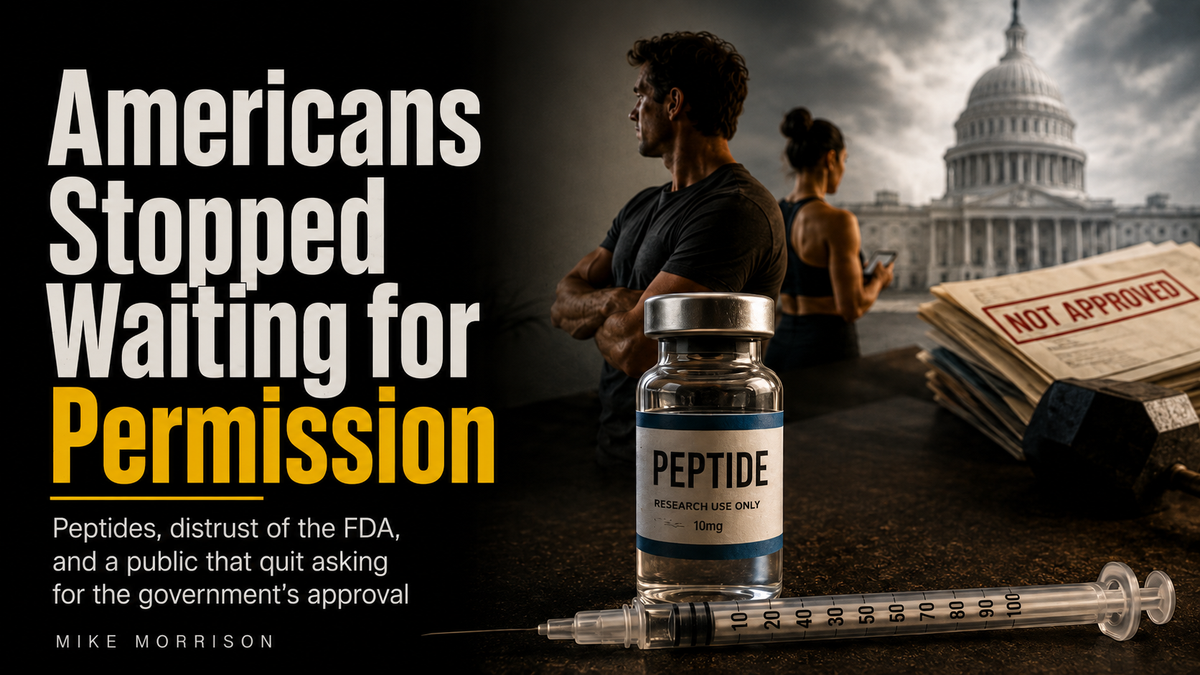
 Michael D. Morrison
ABOUT: Mike Morrison is a writer, speaker and longtime practitioner whose work focuses on public safety, accountability, personal responsibility and the changing relationship between Americans and the institutions they have traditionally relied upon.
Since October 2025, Morrison has personally lost 70 pounds, dropping from 240 pounds to 170 through disciplined diet, consistent gym training, hard work and the use of peptides. That experience led him to look much more closely at the rapidly expanding peptide movement, the results people are reporting, the science behind the compounds and the reasons ordinary Americans are increasingly taking a more active role in decisions about their own health.
His current peptide series examines that movement from the perspective of a consumer and writer, not a physician, with an emphasis on separating documented facts from marketing claims while keeping the discussion understandable to people outside the medical community.
Across nearly 200 published discussions, Morrison has built his writing around firsthand experience, independent research and a simple question: what is actually happening in the lives of the people affected by the systems, policies and technologies we are being asked to trust?