Who Pays for Accountability?
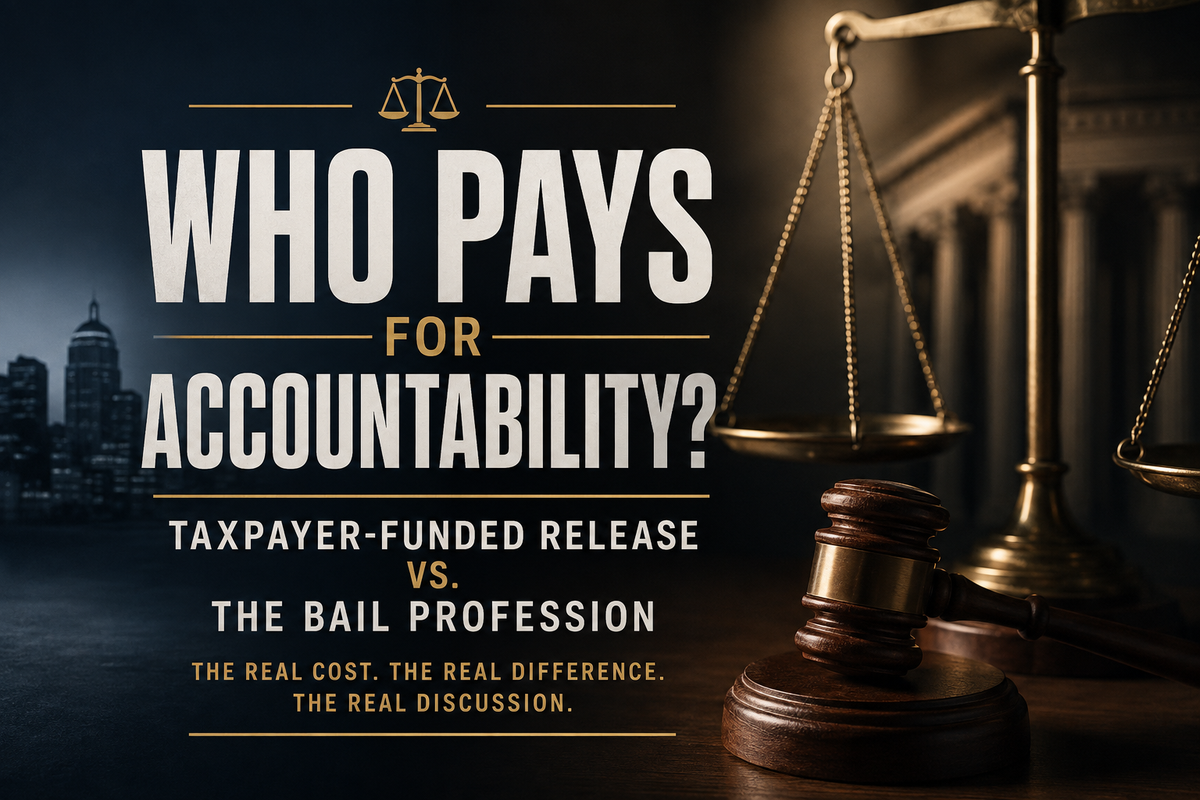
The Difference Between Taxpayer-Funded Release and the Bail Profession
There is a part of the bail debate that rarely receives the attention it deserves: who pays for the system?
When government creates a taxpayer-funded pretrial release program, somebody has to pay for the building, office space, utilities, computers, vehicles, equipment, salaries, payroll taxes, insurance, retirement benefits, training, supervision, administration, and everything else necessary to operate it. None of that is free. The bill is simply transferred to the taxpayer.
The bail profession operates very differently.
Bail agents maintain their own offices. We buy our own vehicles. We pay our own employees, insurance, utilities, equipment, licensing costs, taxes, and operating expenses. We work nights, weekends, holidays, and whenever a defendant or family needs assistance. When a defendant is released through a surety bail bond, the taxpayers are not being asked to finance another government agency to manage that release.
But the difference becomes even more important when a defendant fails to appear in court.
A judge can issue a warrant, and that warrant remains available to law enforcement. But law enforcement agencies have limited personnel, limited budgets, and more immediate public-safety responsibilities. Officers generally are not spending their days searching neighborhoods for every defendant who missed a court appearance. In many cases, the warrant is served when the defendant later encounters law enforcement through a traffic stop, another arrest, or some other contact.
That system may eventually work. It is not necessarily timely.
A bail agent has an entirely different incentive and obligation.
When our client fails to appear, we begin looking for that person. State law gives bail agents authority to locate, arrest, and return defendants who have failed to comply with their obligations. That pursuit can cross city and county lines, and when necessary it can extend much farther. The objective is simple: find the defendant and return that person to the jurisdiction where the case belongs.
And there is something else government-funded release programs cannot duplicate.
A surety bail bond creates financial accountability outside government. The defendant and often members of the defendant's family have signed an agreement and accepted responsibility for ensuring that person returns to court. If the defendant disappears and the conditions of the bond are not satisfied, real money is at risk. The bail agent and surety can ultimately be responsible for the amount of the bond.
That changes the equation.
The bail profession does not simply help someone walk out of jail. We help make sure that person comes back to court.
For more than a century, surety bail has operated through a straightforward structure: private businesses assume financial risk, defendants receive their constitutional opportunity for pretrial release, courts receive an additional layer of accountability, and taxpayers are not required to build another government bureaucracy to perform the same function.
That does not mean every defendant should be required to post a commercial bail bond. Judges have numerous release options available to them, and circumstances vary from case to case. But when policymakers discuss replacing surety bail with government-funded programs, the comparison should be complete.
What does the government program cost?
Who supervises the defendant?
Who searches for the defendant after a failure to appear?
How quickly does that search begin?
Who bears the financial risk when the defendant disappears?
And ultimately, who pays the bill?
Bail agents are sometimes discussed as though we exist outside the communities we serve. We do not. We live here. Our spouses live here. Our children and grandchildren live here. We shop in the same stores, drive the same roads, attend the same churches, support the same schools, and want safe communities for our families just like everyone else.
Public safety is personal to us too.
Efficient. Legal. Court-tested. Privately funded. Community-minded.
That is the bail profession.
And before taxpayers are asked to spend millions building government programs to replace it, perhaps we should first ask a very simple question:
What exactly are taxpayers being asked to pay for that the bail profession is already providing at no expense to them?
About the Author
Mike Morrison is the 2026 PBUS National Bail Agent of the Year and President of the Mississippi Bail Agents Association. With more than 35 years of hands-on experience as a licensed bail agent and owner of Mike Morrison Bail Bonding Company in Hattiesburg, Mississippi, he brings a practical, real-world perspective to his writing on criminal justice, constitutional rights, public safety, government accountability, taxation, technology, and public policy.
Morrison has published nearly 200 articles examining the decisions, institutions, and policies that affect working Americans. His writing is grounded in experience rather than theory, drawing from decades spent in courtrooms, jails, communities, and the criminal justice system. His commentary has earned more than one million views across social media in 2026 alone.
He regularly presents on bail policy and professional standards at the Mississippi Judicial College and leads ethics and training programs for bail professionals nationwide.
Independent, plain-spoken, and focused on accountability, Mike writes about the intersection of government, liberty, public safety, and the real-world consequences of policy decisions on Mississippi families and the nation.
© 2026 Mike Morrison. All rights reserved.