When the System Breaks Down - Bricen Rivers Case
This case hits far too close to home for bail agents across the United States who have followed the death of Lauren Johansen and the questions surrounding what happened before it.
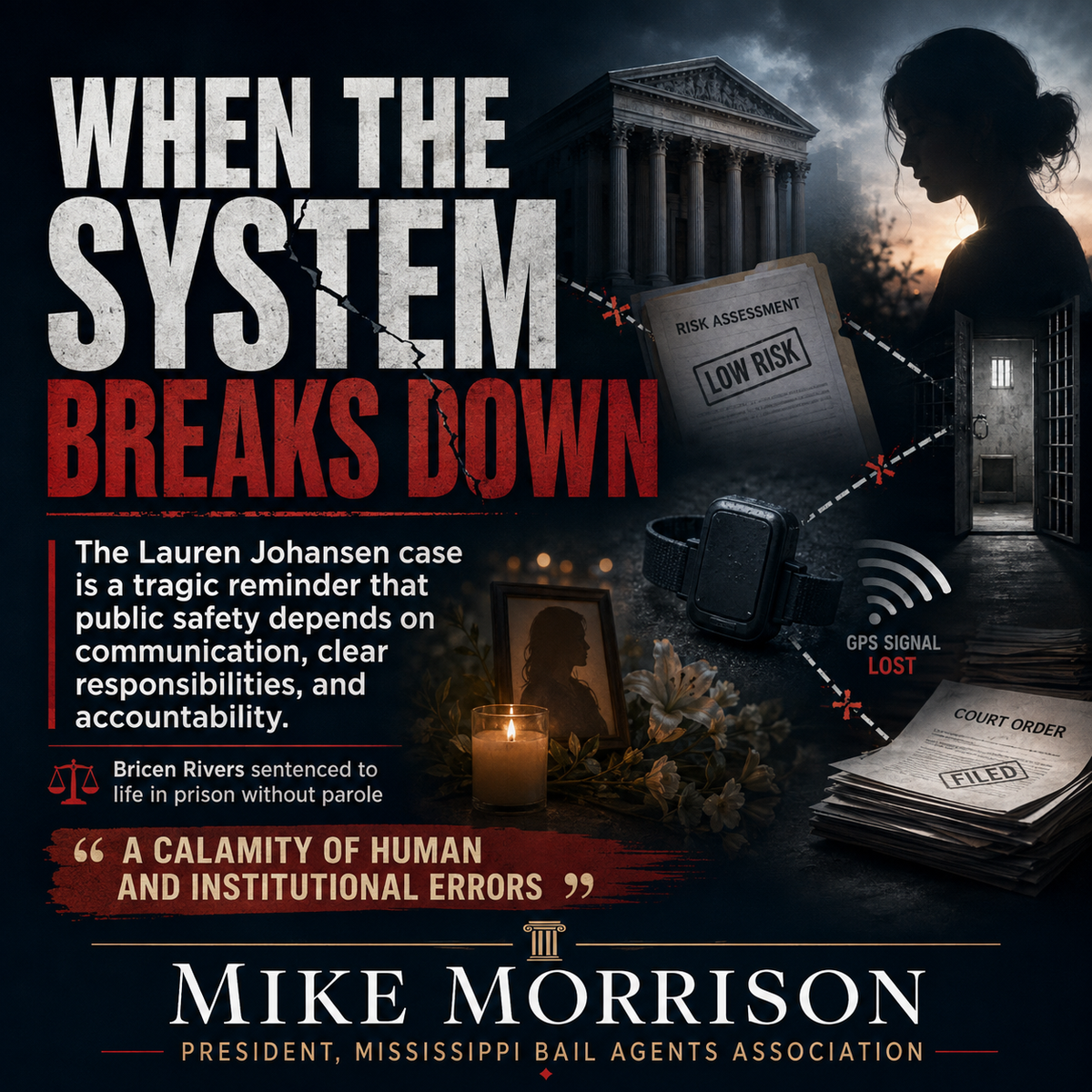
Today, Bricen Rivers pleaded guilty to killing Lauren and was sentenced to life in prison without the possibility of parole. Rivers is responsible for taking Lauren’s life. But the history leading up to that horrible day should concern everyone who works within the criminal justice system.
The record involves a judge, court staff, a jail, bail agents, GPS monitoring companies, prosecutors and law enforcement. Rivers had specific conditions requiring GPS monitoring, prohibiting contact with Lauren and restricting him to Davidson County. Yet the complete conditions did not reach the jail, he was released after the designated monitoring company had closed, another monitoring provider became involved, information about his restrictions was incomplete, violations followed, and the communication necessary to connect all of those moving pieces broke down. A six-judge Tennessee panel would later describe the release process as a “calamity of human and institutional errors.” The same panel ultimately found that the bonding companies had not violated the local court rules then in effect.
There is an important lesson here for our profession. The more people and organizations involved in supervising a defendant, the more critical clearly defined responsibilities and immediate communication become. A GPS monitor does not protect anyone by itself. A court order sitting in one office does not protect anyone. A violation noticed by one participant but not effectively communicated to the people with authority to act does not protect anyone. Every handoff in that process has to work.
Bail agents should use this case to examine our own procedures. Do we have the complete court order before accepting responsibility? Do we know every condition placed on the defendant? Does the monitoring company have exactly the same information? Who receives a violation notice? Who contacts the court or law enforcement? Who has the authority to surrender the defendant? What happens after hours? And most importantly, is everyone assuming someone else is handling something that no one has actually confirmed?
Those are not theoretical questions. In this case, Rivers returned to Nashville after violations had already become known and was fitted with replacement GPS equipment, yet he later returned to Mississippi. By July 2, a warrant had been issued. Lauren Johansen was killed that same day.
Nothing we say now will undo the harm suffered by Lauren or her family. What we can do is study every breakdown exposed by this case and make our own systems stronger. Courts, jails, bail agents, monitoring companies, prosecutors and law enforcement are separate parts of the process, but public safety depends upon those parts communicating and functioning together.
We all must do better.
Mike Morrison
President
Mississippi Bail Agents Association
About the Author
Mike Morrison is the 2026 PBUS National Bail Agent of the Year, President of the Mississippi Bail Agents Association, and a nationally recognized bail educator, speaker, and criminal justice commentator. With more than 35 years of hands-on experience as a licensed Professional Bail Agent and owner of Mike Morrison Bail Bonding Company in Hattiesburg, Mississippi, he brings a practical, real-world perspective to discussions involving bail, criminal justice, constitutional rights, public safety, government accountability, technology, and public policy.
Morrison is recognized as a bail trainer by the Mississippi Judicial College and has been invited to present before judges, justice court clerks, prosecutors, bail professionals, and other criminal justice stakeholders, including as a guest speaker for the Mississippi Attorney General’s Office. He also leads professional education and ethics programs for bail agents across the country through the Master Class Bail Agent Series and other national training initiatives.
He has published nearly 200 articles examining the institutions, policies, and decisions that affect working Americans. His writing is grounded in decades spent inside courtrooms, jails, communities, and the criminal justice system, and his commentary has reached more than one million views across social media in 2026.
Independent, plain-spoken, and focused on accountability, Morrison writes and speaks about the intersection of government, liberty, public safety, professional responsibility, and the real-world consequences of public policy in Mississippi and across the nation.
© 2026 Mike Morrison. All rights reserved.