Understanding the "Anti-Surety Movement"
Why the Fight Over Professional Surety Bail Is Really a Fight Over Accountability
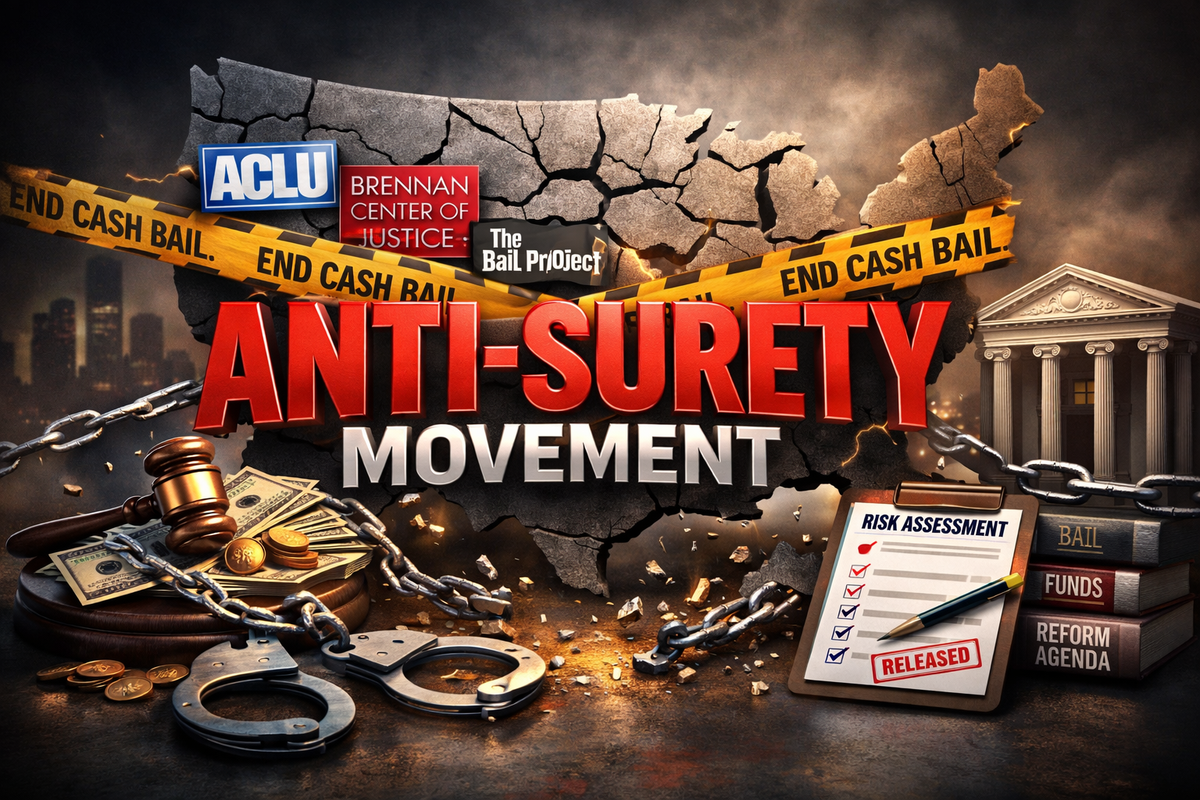
During the Professional Bail Agents of the United States Winter Conference, I introduced a term for something bail professionals across America have been watching develop for years: the Anti-Surety Movement.
The term does not describe one corporation, one nonprofit organization, or one formally incorporated coalition. There is no single headquarters and no membership card.
What exists is something broader.
Across the country, foundations fund pretrial research. Policy organizations publish reports. Advocacy groups promote those findings. Civil-rights organizations litigate cases challenging financial conditions of release. Nonprofit bail funds use their operations and collected data to advocate for systemic change. Technical-assistance organizations work with courts and local governments. National organizations develop standards for government-operated pretrial systems. Successful reforms in one jurisdiction become examples used to promote similar changes somewhere else.
These organizations do not all operate the same way, and they do not necessarily agree on every detail. But substantial portions of this network share a documented policy direction: reducing or eliminating financial conditions of release and replacing Professional Surety Bail with government-administered pretrial systems, unsecured release, recognizance release, nonprofit bail programs, risk-based detention models, or other alternatives.
That is what I mean by the Anti-Surety Movement.
The Network Is Larger Than Most Bail Professionals Realize
The list extends well beyond one or two familiar organizations.
The American Civil Liberties Union, Brennan Center for Justice, Vera Institute of Justice, The Bail Project, Southern Poverty Law Center, Civil Rights Corps, MacArthur Justice Center, Equal Justice Under Law, Pretrial Justice Institute, National Association of Pretrial Services Agencies, Color Of Change, Community Justice Exchange and its National Bail Fund Network are among the organizations that have participated in litigation, research, advocacy, technical assistance, campaigns, or policy development involving bail and pretrial release.
Major foundations and philanthropic organizations also play an important role.
The John D. and Catherine T. MacArthur Foundation launched the Safety and Justice Challenge as a national initiative involving local jurisdictions and criminal-justice organizations. MacArthur reported that by 2022 it had awarded nearly $300 million to organizations participating in the initiative. Earlier, it described the network as a collaborative involving 51 jurisdictions in 32 states and identified organizations such as the Pretrial Justice Institute, Vera Institute of Justice, Urban Institute, Justice System Partners and others as technical-assistance providers.
The relationship with the Pretrial Justice Institute is particularly revealing. MacArthur's own grant records show nine grants totaling more than $16.8 million between 2011 and 2024. Its 2024 grant description says the funding supports PJI in organizing, convening and coordinating activities of the Safety and Justice Challenge network.
That is documented funding for organization and coordination within a national reform network.
Arnold Ventures represents another significant funding and research component. Its criminal-justice grantmaking has financed research involving financial conditions of release, pretrial detention, bail litigation, risk assessment, court appearance and state reform efforts. In 2024 alone, disclosed grants included research on statewide bail changes in Illinois, Colorado and Wisconsin, bail litigation in North Carolina, and bail reform in Shelby County, Tennessee.
Arnold Ventures continues to publish and sponsor discussions about redesigning the pretrial system and reducing reliance on financial conditions of release.
The Litigation Network
The legal organizations involved in this movement frequently work together.
The Southern Poverty Law Center and Civil Rights Corps spent years jointly investigating bail practices in Knox County, Tennessee, and together pressed local officials to change those practices.
In Mississippi, the Southern Poverty Law Center and the Roderick and Solange MacArthur Justice Center investigated Meridian's court practices. The resulting agreement eliminated secured financial bail in virtually all misdemeanor cases there. SPLC also reported similar work affecting other Mississippi municipalities.
The MacArthur Justice Center and Civil Rights Corps have jointly pursued federal litigation challenging financial bail in New Orleans. They were co-counsel in Caliste v. Cantrell and other litigation involving Orleans Parish bail procedures.
The same organizations also worked together in Cook County, Illinois, where the MacArthur Justice Center describes its partnership with Civil Rights Corps and private counsel in a federal class action challenging Cook County's financial bail practices.
Equal Justice Under Law openly identifies financial bail as one of its principal areas of litigation and reports bringing numerous cases aimed at changing wealth-based pretrial detention practices.
These are not disconnected events occurring in isolation. The same organizations appear across jurisdictions, sometimes as partners, often using similar constitutional arguments, and repeatedly seeking changes that reduce or eliminate financial conditions of release.
The Advocacy and Messaging Network
The connections are not limited to litigation.
The ACLU and Color Of Change jointly produced the 2017 report Selling Off Our Freedom, which attacked the for-profit bail bond system and explicitly called for its abolition.
Their cooperation continued beyond publication of a report. The organizations later conducted a joint campaign directed at companies and investors connected to bail insurance, encouraging divestment from the bail business.
The Brennan Center continues to publish research and commentary supporting reductions in financial bail and defending reforms in jurisdictions such as New York.
Vera Institute of Justice is even more direct about its objective. Vera states that it is working through legislation and partnerships with governments and communities to end financial bail and eliminate the role of the profit-making bail bond business.
Whether someone agrees or disagrees with those organizations is not the point.
Their objectives are publicly stated.
The Bail-Fund Movement Is Also an Advocacy Movement
Nonprofit bail funds are sometimes presented simply as charitable organizations paying bonds for individuals who cannot afford release.
That is only part of the picture.
Community Justice Exchange says its National Bail Fund Network includes more than 90 community bail and bond funds. It explains that those funds participate in campaigns seeking to end financial bail and pretrial detention. More importantly, the organization says the network was intentionally created to prevent individual bail funds from operating in isolation and to build what it calls a coordinated advocacy force.
The Bail Project also makes its policy objectives clear.
Its annual reports describe a mission of ending financial bail and replacing it with another pretrial system. Its strategy includes advocacy, policy campaigns, coalition activity, original research, media work and the use of data collected through its own operations to support systemic change.
This is one of the most important characteristics of the Anti-Surety Movement.
Research does not remain inside the organization that produces or funds it. Reports move into advocacy. Advocacy moves into media coverage. Findings are cited by other organizations. Litigation produces policy changes. Those changes become examples for other jurisdictions. Bail funds generate data that is later used to support policy campaigns.
It is a continuing exchange of research, messaging, litigation, funding and policy development.
Government Pretrial Systems Are the Replacement Model
The objective is not simply to criticize Professional Surety Bail. Something has to replace it.
The National Association of Pretrial Services Agencies provides one of the clearest descriptions of that replacement structure. Its standards support independent government pretrial-services agencies, validated pretrial outcome assessments, individualized supervision conditions and abolition of financial conditions of bail.
MacArthur's Safety and Justice Challenge has funded local jurisdictions while providing access to national technical-assistance organizations. Strategies vary by location, but they have included expanded pretrial services, alternatives to detention, changes in release practices and other efforts aimed at reducing jail populations.
This matters because responsibility does not disappear when Professional Surety Bail is removed.
Someone still has to monitor defendants, administer supervision conditions, respond to failures to appear, locate defendants when warrants are issued, and pay for the employees, technology and administration involved.
The question is who assumes those responsibilities.
What Professional Surety Bail Actually Is
The Anti-Surety Movement has been very successful at framing the debate around what it commonly calls “money bail.”
I do not use that term to describe Professional Surety Bail.
I consider it a derogatory political label that collapses several very different release mechanisms into one phrase and makes the existence of money sound like the defining feature of the system.
It is not.
Professional Surety Bail is a guarantee.
A defendant or family working with a professional bail agent is not ordinarily required to hand the court the entire face amount of the bond. The client pays a premium representing a fraction of that amount, according to the law governing that jurisdiction. In return, the professional bail agent and surety stand behind the full face amount of the bond subject to the state's forfeiture laws.
That distinction is critical.
If the court sets a $50,000 bond, Professional Surety Bail does not mean the family necessarily produces $50,000 in cash before the defendant can be released.
In Mississippi, state law generally establishes the professional bail premium at 10 percent of the bond amount, with separate provisions for certain categories of bonds. A standard $50,000 bond therefore carries a $5,000 premium while the professional bail agent and surety are guaranteeing the $50,000 obligation to the court.
The premium is not the bail amount.
The surety guarantee is the accountability mechanism.
That financial exposure creates an incentive that does not exist in the same form under recognizance release or a government reminder program. When the defendant fails to appear and a forfeiture is entered, the professional bail agent and surety can face financial consequences and, depending on state law, must take action to resolve that obligation.
Professional Surety Bail therefore involves a defendant obligation, a third-party guarantee, private capital at risk and a mechanism tied directly to court appearance.
That is why terminology matters.
If Professional Surety Bail accepts the language created and promoted by organizations seeking to eliminate it, the profession begins the debate inside someone else's definition of what bail is.
Measuring What Happens After Release
The Anti-Surety Movement generally emphasizes the consequences of pretrial detention and the ability of defendants to obtain release. Those are legitimate issues for any justice system to examine.
But release cannot be the final measurement.
The defendant must return to court. Judges must be able to enforce their orders. Victims and witnesses remain involved. Warrants created by failures to appear must eventually be served. New criminal conduct while a case is pending must be counted. Government pretrial programs have costs that must be measured.
Different reform organizations point to data they believe demonstrate successful outcomes. The Bail Project reports high appearance rates among its clients, while Brennan Center research argues that jurisdictions reducing financial bail did not experience crime increases attributable to those reforms.
Those claims should be examined on their merits.
Professional Surety Bail should be examined the same way.
A meaningful comparison should include court appearance, failures to appear, outstanding warrants, time required to return defendants to court, rearrest during the pretrial period, serious new offenses, case disposition, length of pretrial supervision, taxpayer expenditures and the administrative burden placed on courts and law enforcement.
If policymakers cannot measure those outcomes consistently, they cannot honestly determine which system performs better.
That is the accountability test.
Why the Term Anti-Surety Movement Matters
The term Anti-Surety Movement was never intended to suggest that every reform organization takes orders from one central authority.
That is not necessary for a network to exist.
The documented record shows funding relationships, joint litigation, joint publications, coordinated campaigns, technical-assistance networks, nonprofit bail networks, research grants, government partnerships and overlapping policy objectives.
Viewed individually, each grant, lawsuit, report, campaign or pilot program can appear independent.
Viewed together, the broader structure becomes much easier to see.
That is the Anti-Surety Movement.
The Real Debate Is Accountability
This discussion should not be reduced to whether every defendant should remain in jail. Professional Surety Bail does not require that position.
Nor should every reform be rejected simply because a national organization supports it.
The real question is what happens when theory becomes practice.
Does the defendant appear?
Can the court enforce its order?
Who assumes responsibility when the defendant does not comply?
Who bears the financial risk?
What does the replacement system cost?
What happens to victims and witnesses when cases are delayed?
And can the system prove, with consistent long-term data, that the replacement works better?
Those questions should follow every reform proposal regardless of who funds it, publishes it or promotes it.
Professional Surety Bail places a private financial guarantee behind the defendant's obligation to return to court. That structure is not accurately explained by reducing it to “money bail.”
It is Professional Surety Bail.
The national movement working to reduce or eliminate that system is not one organization. It is an interconnected network of funders, litigators, researchers, advocates, bail funds, technical-assistance providers and government programs moving repeatedly toward the same broad objective.
That is why the Anti-Surety Movement deserves to be named, studied and measured.
Because the future of pretrial justice should not be decided by slogans from either side.
It should be decided by what actually produces appearance, compliance, accountability, public safety and a justice system capable of proving that it works.
About the Author
Mike Morrison is the 2026 PBUS National Bail Agent of the Year, President of the Mississippi Bail Agents Association, and a nationally recognized bail educator, speaker, and criminal justice commentator. With more than 35 years of hands-on experience as a licensed Professional Bail Agent and owner of Mike Morrison Bail Bonding Company in Hattiesburg, Mississippi, he brings a practical, real-world perspective to discussions involving American legal history, institutional accountability, constitutional rights, public safety, technology, and public policy.
Morrison is recognized as a bail trainer by the Mississippi Judicial College and is a sought-after guest speaker for judicial, prosecutorial, and industry conferences across the country. He has presented before state judges, justice court clerks, prosecutors, attorneys general staff, and bail professionals nationwide. He also leads professional education and ethics programs for bail agents through the Master Class Bail Agent Series and other national training initiatives.
He has published nearly 200 articles examining the institutions, policies, and decisions that affect working Americans. His writing is grounded in decades spent inside courtrooms, jails, communities, and the criminal justice system, and his commentary has surpassed 1.75 million views across social media in 2026.
Independent, plain-spoken, and focused on accountability, Morrison writes and speaks about the intersection of government, liberty, public safety, professional responsibility, and the real-world consequences of public policy in Mississippi and across the nation.
© 2026 Mike Morrison. All rights reserved.