The Same Source, Twice
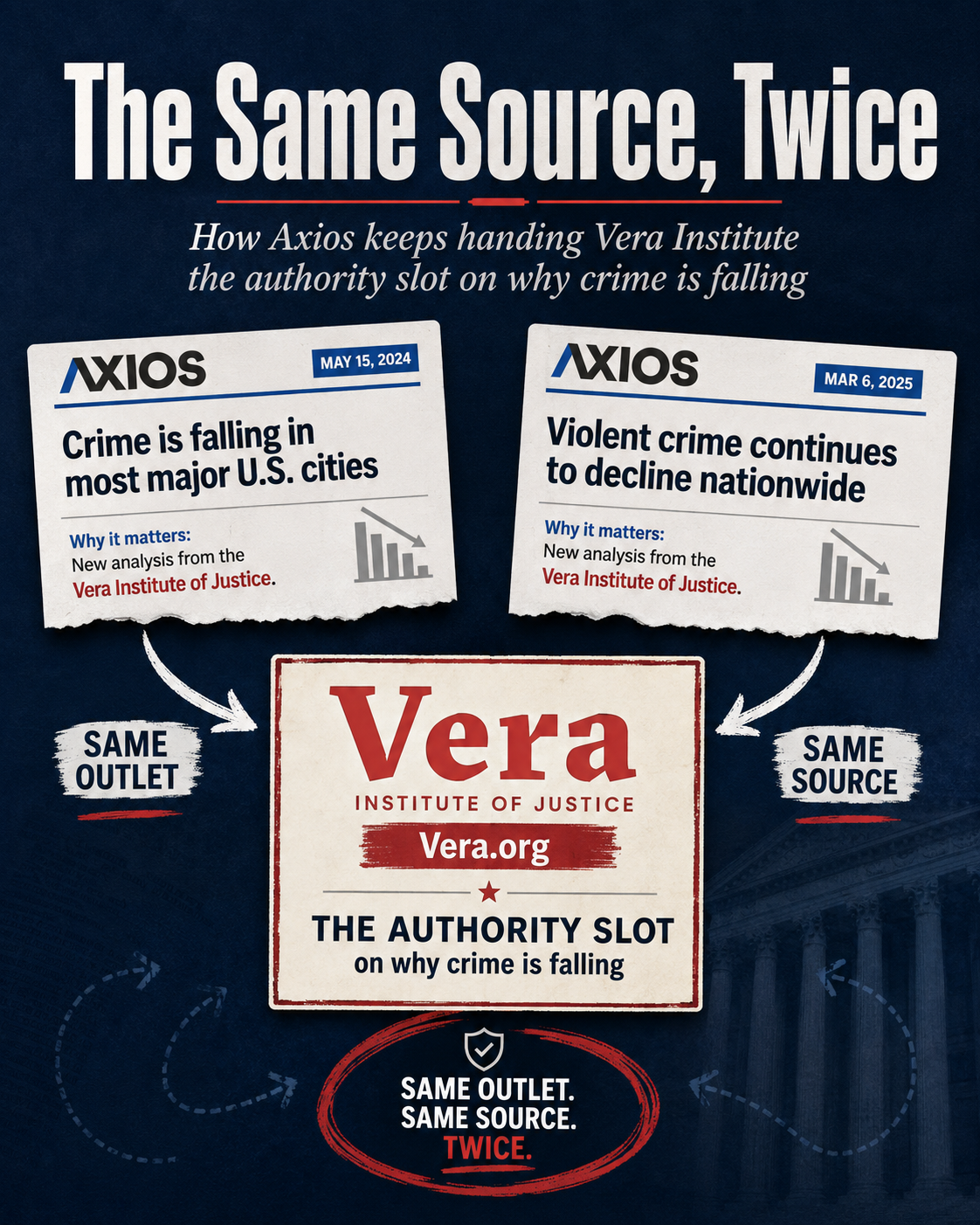
How Axios keeps handing Vera Institute the authority slot on why crime is falling
Axios has now run two separate stories on the historic 2025-2026 crime decline. Both times, the outlet turned to the same person to discount enforcement as an explanation: Insha Rahman, president of the Vera Institute of Justice. Both times, Axios labeled her contribution “the other side” or folded her into a “Reality check” dismissing prosecution and enforcement. Neither time did Axios tell readers that Vera’s stated institutional objective is to eliminate the private bail industry.
That is not a coincidence worth ignoring. It is a pattern worth naming.
The First Story
In the first piece, Axios asked whether aggressive prosecution deserved credit for falling crime. Rahman argued it did not — that investments in youth employment, mental health treatment, and community violence intervention were the real drivers. Axios then paired her with another source to declare, in its “Reality check,” that there is little evidence aggressive prosecutions drove the national decline.
Vera does not hide what it wants. The organization has said plainly that it is working to end money bail and to eliminate the role of the private bail bond industry. That is a legitimate position for an advocacy group to hold. It is not a neutral one. When a reader is told Rahman represents “the other side” of a debate over what reduces crime, that reader deserves to know the other side has an institutional stake in prosecution and enforcement getting no credit.
The independent Council on Criminal Justice reached a more careful conclusion than either side of that framing allowed. Its July 2026 analysis found no single or easy explanation for the decline, and specifically listed changes in criminal-justice operations and strategies among the possible contributors — alongside technological advances and broader social change. The FBI, looking at the same year, noted that violent crime fell dramatically while roughly 414,000 arrests for violent crimes were still made. Axios gave Vera the floor to wave off prosecution. The evidence does not support waving it off.
The Second Story
The August 24, 2026 follow-up is a broader piece, and a fairer one on its face. It lists several theories for the decline: falling alcohol and drug use since the pandemic, AI-driven policing tools, an aging population, and even GLP-1 weight-loss drugs linked to reduced impulsivity. Most of that reporting has nothing to do with bail or prosecution, and none of it needs to be attacked.
But the structure repeats. Rahman appears again, again introduced as “the other side,” again arguing that city investments in youth programs and crisis response — not enforcement — explain the drop. And once more, Axios’s only “Reality check” in the piece uses her to declare there is little evidence that National Guard deployments or aggressive prosecutions drove the national decline.
This time she is paired with Leonard Adam Sipes Jr., a former Justice Department statistics specialist, and it is worth being precise about that: Sipes is not Vera-affiliated, and his inclusion complicates any claim that Rahman is operating alone. Fairness requires keeping that pairing intact. But it does not change the underlying pattern. Two stories, one topic, one advocacy president with a declared institutional interest, called on twice to be the voice that discounts enforcement — and twice presented to readers without that interest disclosed.
The Gap in the Logic
Both “Reality check” passages rest on the same reasoning: crime fell even in cities that did not toughen prosecution or deploy the National Guard, so prosecution and enforcement get little credit. That establishes only that enforcement changes cannot explain the entire national decline by themselves. It does not establish that enforcement had no effect in the places where it was actually applied. Multiple causes can operate at once. A nationwide trend line proves nothing about what mattered in Washington, D.C., or Memphis, where prosecutors and officials made specific, documented claims about specific, local results.
The Standard Should Run Both Ways
Bail agents get asked constantly to account for their financial interest before anyone credits what they say about pretrial accountability. That is a fair question. It should be asked of everyone in this debate. Vera Institute of Justice is not a disinterested research shop weighing in on crime statistics. It is an advocacy organization with a stated goal of ending the industry bail agents work in, and its president has now been used twice by the same outlet to discount the case for enforcement — without once being identified as anything other than “the other side.”
Readers do not need Axios to stop quoting Rahman. They need to be told, plainly, what she is arguing for when she argues.
https://www.axios.com/2026/08/24/violent-crime-decline-theories
ABOUT: Mike Morrison has spent 35 years working as a Professional Bail Agent in Mississippi, building a career grounded in firsthand experience with defendants, families, courts, law enforcement and the day-to-day realities of the criminal justice system. His commitment to education has led to recognition as a bail trainer by the Mississippi Judicial College and invitations to speak before judges, justice court clerks, prosecutors and other criminal justice professionals, including as an invited guest speaker for the Mississippi Attorney General’s Office.
For nearly two years, Morrison has worked to develop the Master Class Bail Agent Series with one goal: to elevate the knowledge, professionalism and value of the modern Bail Agent. The series draws from decades of practical experience and focuses on giving Bail Agents a deeper understanding of the laws, procedures and responsibilities that allow them to better serve their clients, their courts and their profession.