The Morning America Changed
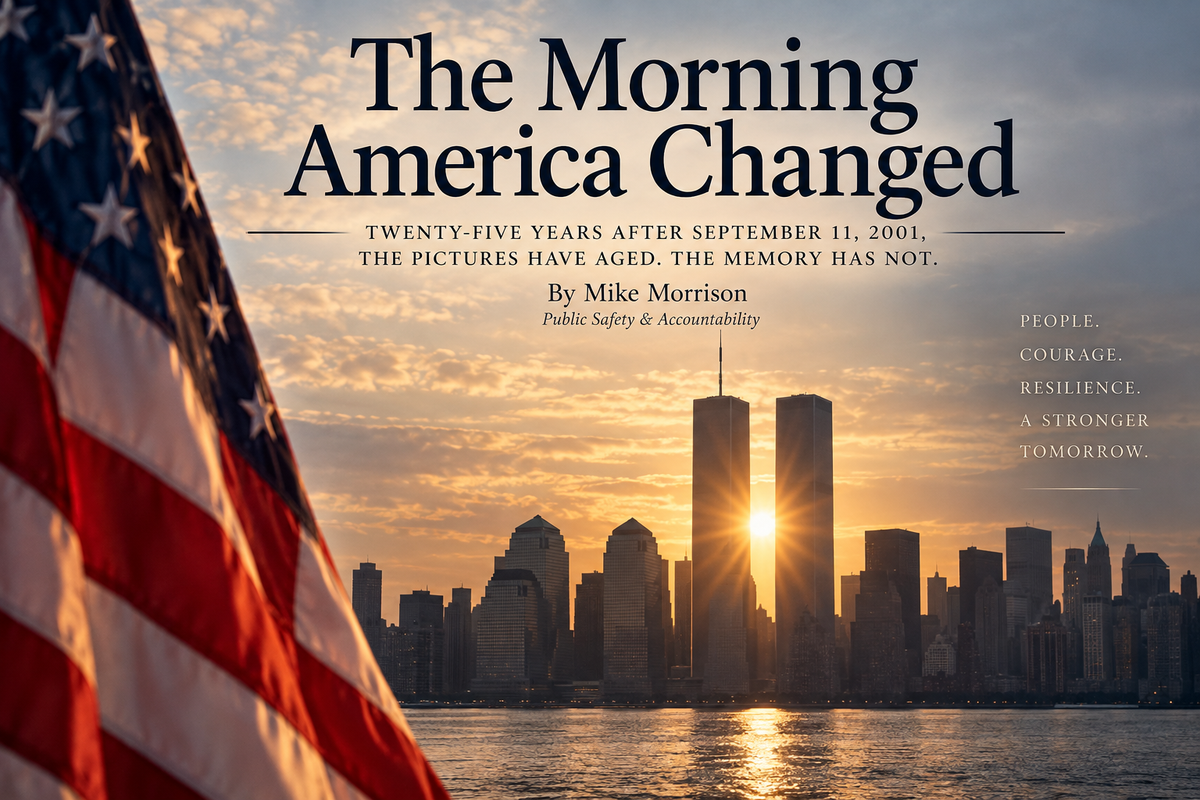
Twenty-five years after September 11, 2001, the pictures have aged. The memory has not.
September 11, 2001, began as an ordinary Tuesday morning, which may be one reason the memory remains so powerful twenty-five years later. People drove to work, children arrived at school, airplanes climbed into clear skies, and families moved through routines they had followed hundreds of times before. Here in Mississippi, we were beginning another weekday with no reason to believe that before lunchtime we would be watching one of the defining events of our lifetime.
At 8:46 a.m., American Airlines Flight 11 struck the North Tower of the World Trade Center. The first reports produced confusion because there was no immediate reason to imagine that a commercial airliner had deliberately been flown into the building. At 9:03, United Airlines Flight 175 struck the South Tower in full view of television cameras, removing any doubt that the country was facing a coordinated attack. American Airlines Flight 77 hit the Pentagon at 9:37. The South Tower collapsed at 9:59. Four minutes later, United Airlines Flight 93 crashed near Shanksville, Pennsylvania, after passengers and crew members fought the hijackers. At 10:28, the North Tower collapsed. The central events of the attack had unfolded in only 102 minutes.
Chronology can tell us what happened, but it cannot reproduce what that morning felt like. Those of us watching from Mississippi were spectators to something almost impossible to comprehend, with television carrying images into our homes and workplaces faster than the mind could absorb them. There was no social media feed refreshing every few seconds and no smartphone in every hand. Millions of Americans were watching the same television networks, listening to the same uncertain reports and wondering whether the attacks were over or whether something else was coming. Helplessness became part of the experience because we could see people desperately needing help while knowing there was absolutely nothing most of us could do for them.
Inside New York, others were confronting a very different reality. Firefighters entered the World Trade Center carrying equipment up crowded stairwells while office workers struggled downward toward safety. Police officers and Port Authority officers directed evacuations and cleared streets. Paramedics and emergency medical personnel established treatment areas amid rapidly deteriorating conditions. Three hundred forty-three members of the New York City Fire Department died that day, along with law-enforcement officers and other emergency personnel. They made decisions without knowing how much time remained, what conditions awaited them above or whether additional attacks were underway, and that uncertainty is part of what makes their actions so remarkable.
Elsewhere in lower Manhattan, an extraordinary civilian response developed along the waterfront. Bridges, tunnels and portions of the transportation system had been shut down, leaving large numbers of people searching for a way out. Ferries, tugboats, commercial vessels and private boats began moving people across the water. Captains and crews who had expected a routine day became part of a massive improvised evacuation, carrying hundreds of thousands of people away from Manhattan while smoke still hung over the city. No elaborate national plan produced that response. People saw what was needed and acted.
The passengers and crew of United Airlines Flight 93 confronted perhaps the most terrible knowledge anyone aboard one of the hijacked aircraft possessed that morning. Through telephone calls, they learned that other airplanes had already been used as weapons and understood what the hijackers intended to do with theirs. They chose to resist. Their attempt to retake the aircraft ended in a Pennsylvania field, killing all 40 passengers and crew members aboard, but preventing the plane from reaching its intended target in Washington, believed to have been either the United States Capitol or the White House.
The attacks killed 2,977 innocent people. Behind that number were thousands of individual lives already connected to families, careers, friendships and plans for a future that would never arrive. Some had reported for work in offices high above Manhattan. Others were serving at the Pentagon. Some had boarded airplanes for business trips, vacations or journeys home. Others put on uniforms that morning and answered emergency calls. The annual reading of the victims' names has endured because it prevents a national tragedy of almost unimaginable scale from being reduced to a casualty figure. Each name restores a person to the story.
The emotional aftermath spread through every part of the country. Fear was accompanied by anger, grief and uncertainty about what might come next. Churches filled. Blood-donation centers saw lines of people wanting to help. American flags appeared on houses, businesses, vehicles and highway overpasses. Neighbors checked on one another, and communities held vigils for people they had never known. For a period of time, Americans who disagreed about almost everything else seemed conscious of having endured the same national wound. That unity eventually gave way to the ordinary arguments and divisions of American life, but those who lived through the days immediately following September 11 remember how real it was.
The federal response transformed areas of daily life that Americans had previously taken for granted. Congress created the Transportation Security Administration in November 2001, federalizing airport passenger screening and beginning a sweeping overhaul of aviation security. Checked baggage received greater scrutiny, cockpit protection changed, air marshal deployments expanded and access to secure airport areas became far more restrictive. The Department of Homeland Security was later established, bringing functions from 22 federal departments and agencies into a new Cabinet-level organization. Intelligence sharing and counterterrorism became national priorities in ways that would influence federal policy for decades.
Finding those responsible became one of the largest investigative efforts in American history. Within three days of the attacks, more than 4,000 FBI special agents and approximately 3,000 support personnel had been assigned to the investigation. At its peak, more than half of the Bureau's agents were involved. Investigators followed more than half a million leads while reconstructing how the nineteen hijackers entered the United States, trained, moved money, communicated and prepared for the operation. The investigation established al-Qaeda's responsibility and focused international attention on Osama bin Laden and the terrorist network operating around him.
The hunt for bin Laden crossed national borders and presidential administrations as American intelligence agencies worked to locate him. The breakthrough eventually came through painstaking work tracing the network of couriers surrounding him. On May 2, 2011, Pakistan time, American special operations forces entered a compound in Abbottabad, Pakistan, where bin Laden had been hiding and killed him during the operation. For many Americans, the news brought a measure of justice against the man whose organization had planned the attacks, although nothing could restore the lives that had been lost.
The physical consequences continued for years. Firefighters, police officers, construction workers, recovery personnel, residents and others had been exposed to a toxic mixture of dust, smoke and debris at Ground Zero. Cancers, respiratory diseases and other serious illnesses emerged among those populations, and men and women who survived the attack or worked during the recovery later died from conditions linked to that exposure. September 11 therefore carried a human cost that extended far beyond the people killed that morning.
Millions of Americans now have no personal memory of the World Trade Center standing over Manhattan or of the morning when it was destroyed. For them, September 11 belongs to history, which places a responsibility on those who remember it firsthand. The story must preserve more than the images of collapsing buildings. It must convey the fear and uncertainty of the moment, acknowledge the failures that allowed the attacks to succeed, recognize the courage that emerged in response and explain the changes that followed. History matters because lessons purchased through tragedy should not have to be learned twice.
On this twenty-fifth anniversary, ceremonies at Ground Zero, the Pentagon and Shanksville again bring Americans back to the places where the attacks occurred. Bells sound, moments of silence are observed and families gather with memories that never became historical to them. Across the country, including here in Mississippi, the day remains personal for those who experienced it and instructive for those who did not.
September 11 does not need embellishment to retain its power. The truth of that morning is enough: 2,977 people were taken from their families, extraordinary courage appeared in places of unimaginable danger, and a country discovered how quickly history can arrive without warning. We said we would never forget, and remember we shall.
About the Author
Mike Morrison has served Mississippi's criminal justice system as a licensed bail agent since May 1991. On the morning of September 11, 2001, he was ten years into that career and operating his own firm, Mike Morrison Bail Bonding Company in Hattiesburg, which he founded in 1994. Now in his thirty-sixth year in the profession, he is serving his third term as President of the Mississippi Bail Agents Association and was named the 2026 National Bail Agent of the Year by the Professional Bail Agents of the United States, where he serves as a national representative. He presents on bail policy and the Mississippi Rules of Criminal Procedure at the Mississippi Judicial College and leads the MBAA Master Class Series. He writes on surety bail, pretrial accountability and public safety under the banner Public Safety & Accountability.
© 2026 Mike Morrison. All rights reserved. No part of this article may be reproduced or republished without written permission from the author.