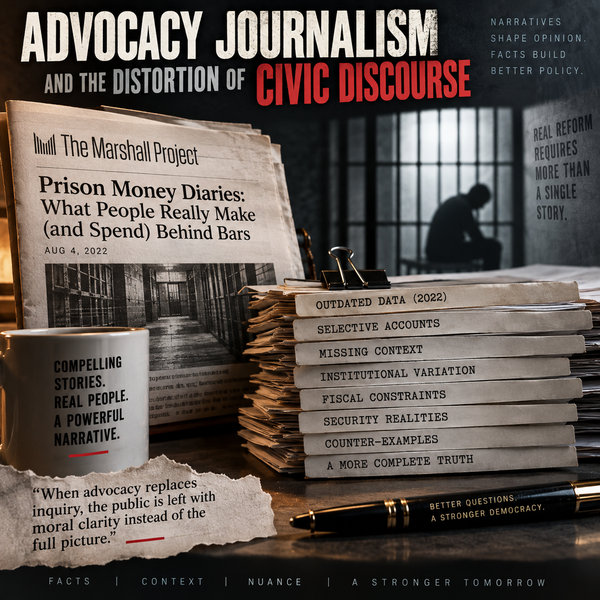
Criminal Justice Reform’s Data Problem: The LEAD Experiment Was Oversold
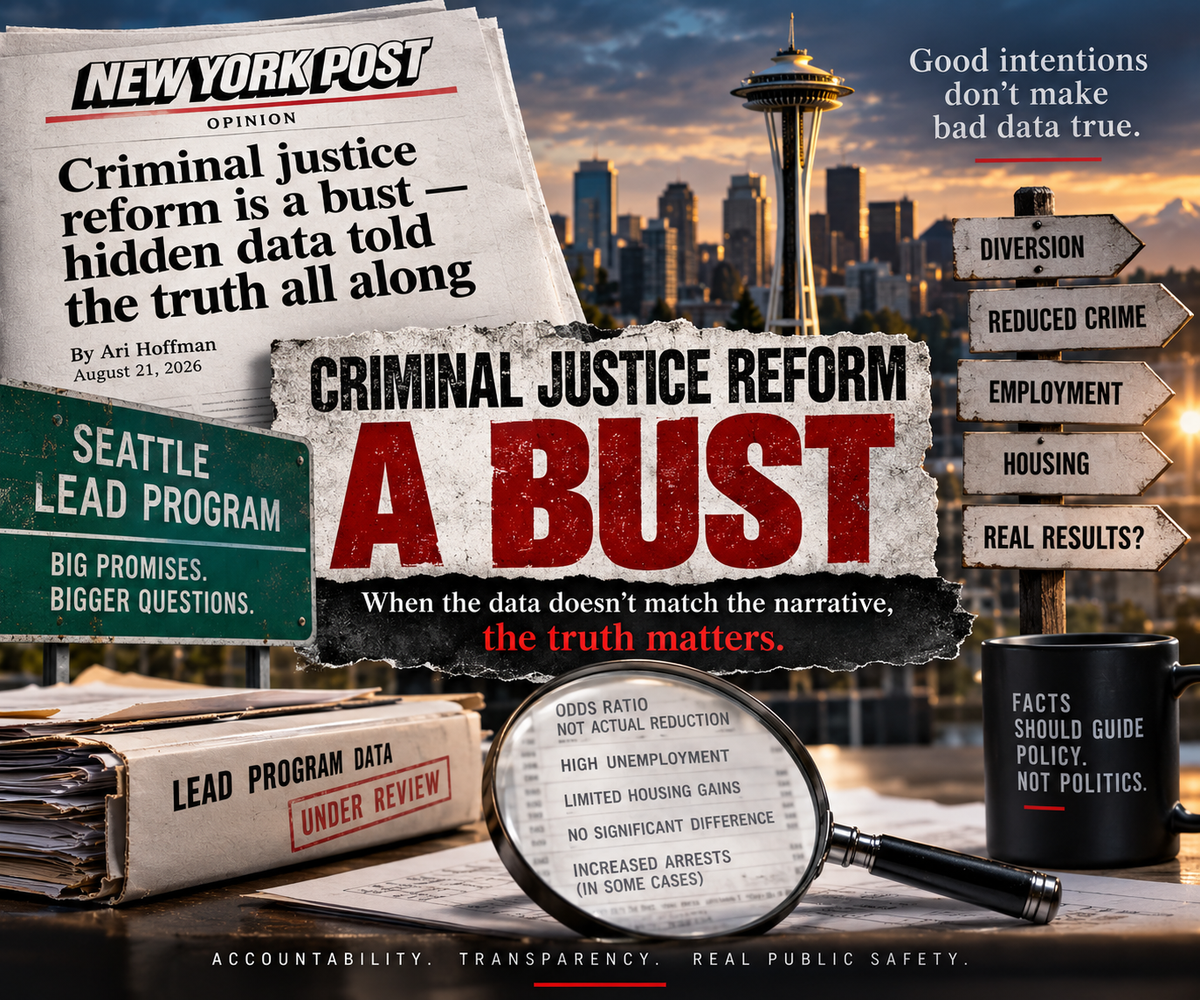
The New York Post just published a clear-eyed takedown of the “evidence-based” diversion model that helped shape bail reform and soft-on-crime policies across blue cities. The numbers never matched the marketing.
Ari Hoffman’s recent New York Post opinion piece lays out what many of us who have watched these policies up close already suspected: large parts of the criminal-justice reform movement were built on shaky or actively misrepresented data.
The centerpiece is Seattle’s Law Enforcement Assisted Diversion (LEAD) program. For more than a decade it was sold as proof that diverting low-level offenders away from jail and into case management dramatically reduced recidivism, improved employment, and got people housed. Promoters repeated a single headline figure—participants were “58% less likely to be arrested”—until it became conventional wisdom. That claim helped LEAD expand to dozens of cities, influenced state legislation, and fed the broader anti-incarceration philosophy behind New York’s 2019 bail reforms and similar experiments elsewhere.
Hoffman notes that when he asked for the underlying data in 2019, none was forthcoming. Now Eric Zimmerman of the Washington Policy Center has examined it. The results are far less impressive than the marketing suggested:
- The famous 58% figure was an odds ratio, not a straightforward reduction in actual arrests. Key metrics showed no clear, statistically significant difference between LEAD participants and a control group.
- Employment outcomes were dismal—roughly 91% of participants remained unemployed during the follow-up period.
- Housing gains were limited; of those who entered without permanent housing, only a small number were housed in any given month over 18 months.
- A Santa Fe replication reportedly saw average arrests increase.
- Meanwhile, the program’s architect received a prestigious MacArthur Fellowship citing those “measurable outcomes,” and federal and state dollars followed the claims.
This is not a minor technical dispute. Policy was sold to the public and to lawmakers on the basis of results that were exaggerated or poorly communicated. The same pattern—promise dramatic reductions in crime and suffering, then resist rigorous independent scrutiny—has appeared in multiple “reform” initiatives. The predictable consequence in many cities has been a revolving door for prolific offenders.
Hoffman is right to demand independent audits and transparent reporting on the outcomes that actually matter: subsequent arrests and charges (not just odds ratios), employment and income, stable housing, mortality, and substance-use results. Taxpayers should not be asked to keep funding models whose original justification does not hold up under closer examination.
The full piece is worth reading in full:
Criminal justice reform is a bust — and hidden data told the truth all along
Feel-good rhetoric and selective statistics are not a substitute for public safety. If diversion programs work, the data should be able to show it clearly and repeatedly. Until then, skepticism is the responsible position.
About the Author
Mike Morrison is the 2026 PBUS National Bail Agent of the Year, President of the Mississippi Bail Agents Association, and a nationally recognized bail educator, speaker, and criminal justice commentator. With more than 35 years of hands-on experience as a licensed Professional Bail Agent and owner of Mike Morrison Bail Bonding Company in Hattiesburg, Mississippi, he brings a practical, real-world perspective to discussions involving bail, criminal justice, constitutional rights, public safety, government accountability, technology, and public policy.
Morrison is recognized as a bail trainer by the Mississippi Judicial College and has been invited to present before judges, justice court clerks, prosecutors, bail professionals, and other criminal justice stakeholders, including as a guest speaker for the Mississippi Attorney General’s Office. He also leads professional education and ethics programs for bail agents across the country through the Master Class Bail Agent Series and other national training initiatives.
He has published nearly 200 articles examining the institutions, policies, and decisions that affect working Americans. His writing is grounded in decades spent inside courtrooms, jails, communities, and the criminal justice system, and his commentary has reached more than one million views across social media in 2026.
Independent, plain-spoken, and focused on accountability, Morrison writes and speaks about the intersection of government, liberty, public safety, professional responsibility, and the real-world consequences of public policy in Mississippi and across the nation.
© 2026 Mike Morrison. All rights reserved.