The Beef & Restaurant Paradox
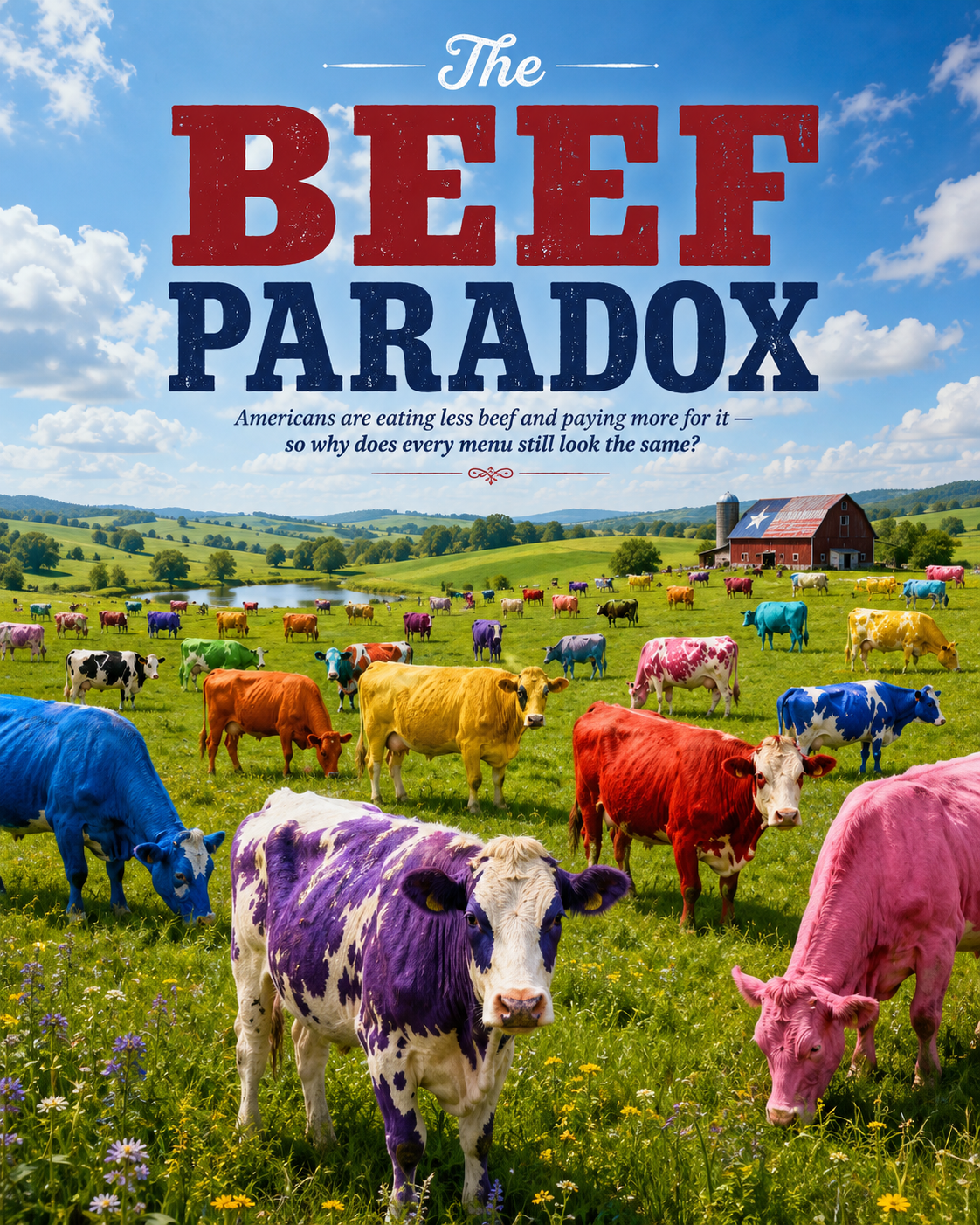
The Beef Paradox
Americans are eating less beef and paying more for it — so why does every menu still look the same?
Fewer Americans are choosing beef than a generation ago, yet much of the restaurant industry still builds its menu as though nothing has changed. Walk into most restaurants outside the handful of cities that treat food as culture rather than fuel, and the choices are remarkably predictable — steak, burger, prime rib on Fridays, chicken, a protein and a starch standing in for a meal. Meanwhile, the people sitting at those tables have changed considerably. Their tastes are broader, their expectations are higher, and many of them simply do not eat the way they did thirty years ago. The diners moved. A lot of the restaurant industry didn't move with them.
That isn't just a question of whether somebody prefers steak or chicken. Plenty of customers don't want beef at all, whether because of health concerns, religious beliefs, cultural traditions or simple preference. Yet in many small and mid-sized markets, removing beef from consideration can eliminate most of the serious entrée choices on the menu. Restaurants talk constantly about attracting new customers, but too many of them continue offering essentially the same food to essentially the same customer they were trying to attract in 1985. If the menu gives somebody little reason to come through the door, the decision to stay home gets made before price ever enters the discussion.
The other change is what Americans now know about food. Cooking shows, food media, international travel and exposure to different cuisines have changed what people recognize as a good meal. A steak and a baked potato can still be excellent, but simply putting them on a plate no longer demonstrates much imagination. Customers have seen different ingredients, different techniques and different ways of building a meal, and they notice when every restaurant in town seems to be serving a variation of the same thing. For people living outside major food cities, finding something genuinely different too often means driving somewhere else.
Then there is beef itself. Prices have reached record levels while cattle herds are at their smallest size since the early 1950s, putting restaurants that depend heavily on beef in a difficult position. They can raise the menu price, absorb the additional cost, reduce the portion or buy a less expensive product. That raises a question worth asking: how many kitchens are quietly stepping down the grade of meat while continuing to charge customers as though nothing changed? I don't have a spreadsheet proving that is happening industry-wide, and I'm not going to pretend I do. But the incentive is obvious. Anyone who has ordered a supposedly premium cut recently and wondered why it chewed like a boot understands why the question is worth asking.
All of this brings me to what may be the more important problem for restaurants: why are more people deciding they would rather eat at home? Grocery prices are higher too, so price by itself does not explain it. Home cooks have better equipment, easier access to quality ingredients and virtually unlimited information about how to prepare them. People who once needed a restaurant to get a well-prepared steak, seafood dish or something outside their normal routine can now learn to make it themselves. When the meal at home is better, prepared exactly the way you want it and does not require paying restaurant prices for something ordinary, staying home stops feeling like the second choice.
That is where I think the restaurant industry needs to pay attention. The competition is no longer just the restaurant across town. It is the customer's own kitchen, combined with a customer who knows more about food, expects more variety and has fewer reasons to settle for the same menu he has been looking at for decades.
None of this means beef is going away. It isn't, and I don't think it should. A great hamburger or a properly prepared steak still has a place on any good menu. But building an entire restaurant around the assumption that familiar food will always be enough is becoming a harder argument to make.
Restaurants have to give people a reason to leave home, and that means more than charging more for the same plate. It means variety, quality, thoughtful preparation and a menu that reflects the people eating today rather than the people restaurants were serving thirty or forty years ago.
Because the real question isn't whether Americans still like beef.
It is whether restaurants have noticed that Americans like a lot of other things too.