Results-Based Ideology (RBI): Moving from Activity to Accomplishment in the Bail Profession

A Framework for Evidence-Based Professional Governance
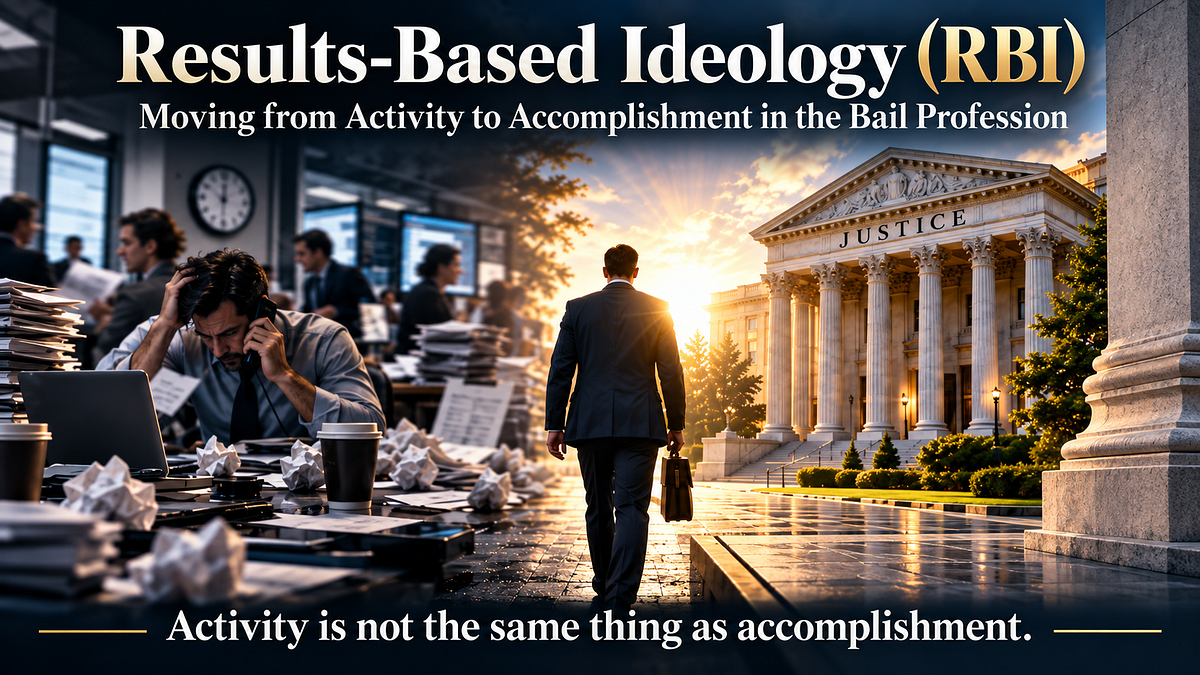
Results-Based Ideology begins with a principle that is simple to state but difficult to practice honestly: activity is not the same thing as accomplishment.
The professional surety bail industry invests substantial time, money, personnel, and organizational energy into education, legislative advocacy, public relations, technology, and daily operations. Yet, those investments are frequently judged by what was done rather than by what was achieved. Meetings held, classes conducted, media placements secured, lawmakers contacted, programs launched, and dollars spent are evidence of activity, but they are not proof of effectiveness.
In an era of intense public scrutiny, evolving regulatory pressures, and aggressive competing narratives, the profession can no longer afford to rely on assumptions or tradition. When external critics challenge professional surety bail or legislative opponents question industry practices, anecdotes and good intentions are not enough to win the debate. To lead the conversation, the profession must become a standard-bearer of empirical proof.
Adopting Results-Based Ideology (RBI) changes the standard. It requires every significant effort to begin with a defined objective and ultimately determine whether the initiative produced a measurable benefit, whether that benefit justified the investment, and whether the evidence supports continuing the same course.
The Shift from Tradition to Evidence
What makes RBI more than another management framework is how it changes the criteria for what works. It requires moving beyond tradition, assumption, personality, and anecdotal success stories toward a culture in which professional performance is examined through evidence.
That does not mean every important result can be reduced to a single number. Trust, relationships, credibility, public sentiment, and political influence can be difficult to quantify. However, difficulty does not eliminate the responsibility to evaluate them. Baselines, trends, proxy indicators, greater access to decision-makers, changes in behavior, improved legislative language, and stronger media accuracy all help establish whether actual progress occurred.
RBI is not about creating bureaucracy or demanding perfect data. It is about refusing to confuse intention with impact, and refusing to continue investing resources in programs simply because they are familiar.
Evaluating Our Initiatives
Applied across the industry, RBI reframes how we evaluate our core functions:
- Continuing Education: Judged by whether professional knowledge, compliance, and performance actually improved over time—not simply by who attended the seminar.
- Legislative Advocacy: Examined by whether collected data and outreach contributed to changes in committee votes, improved policy language, or produced measurable strategic progress, rather than merely counting meetings held.
- Public Relations: Evaluated by whether public understanding, media accuracy, and stakeholder credibility measurably improved, rather than counting press releases issued.
- Business Operations: Measured by whether appearance rates increase, forfeitures decline, collections improve, recovery times shorten, efficiency increases, and client service strengthens.
The central RBI inquiry is not “What did we do?” but “What changed, what did it cost, what did we learn, and what should we do next?” When that question becomes part of our normal operating culture, results—not activity—become the standard by which progress is judged.
Conclusion
Rather than viewing RBI as an indictment of past efforts, the profession can embrace it as an essential tool for long-term self-governance. As we look ahead to our next major organizational initiatives, the standard moving forward must be clear: what single measurable outcome can we commit to tracking from day one to ensure we are actually accomplishing what we set out to achieve?
 Michael D. Morrison
About the Author
Mike Morrison is the 2026 PBUS National Bail Agent of the Year, President of the Mississippi Bail Agents Association, and a nationally recognized bail educator, speaker, and criminal justice commentator. With more than 35 years of hands-on experience as a licensed Professional Bail Agent and owner of Mike Morrison Bail Bonding Company in Hattiesburg, Mississippi, he brings a practical, real-world perspective to discussions involving American legal history, institutional accountability, constitutional rights, public safety, technology, and public policy.
Morrison is recognized as a bail trainer by the Mississippi Judicial College and is a sought-after guest speaker for judicial, prosecutorial, and industry conferences across the country. He has presented before state judges, justice court clerks, prosecutors, attorneys general staff, and bail professionals nationwide. He also leads professional education and ethics programs for bail agents through the Master Class Bail Agent Series and other national training initiatives.
He has published nearly 200 articles examining the institutions, policies, and decisions that affect working Americans. His writing is grounded in decades spent inside courtrooms, jails, communities, and the criminal justice system, and his commentary has reached more than one million views across social media in 2026.
Independent, plain-spoken, and focused on accountability, Morrison writes and speaks about the intersection of government, liberty, public safety, professional responsibility, and the real-world consequences of public policy in Mississippi and across the nation.
© 2026 Mike Morrison. All rights reserved.