Has the American Healthcare System Created Demand for the Alternatives Regulators Are Now Trying to Control?

When the doctor-and-pharmacy route becomes too expensive, demand shifts to the gas station
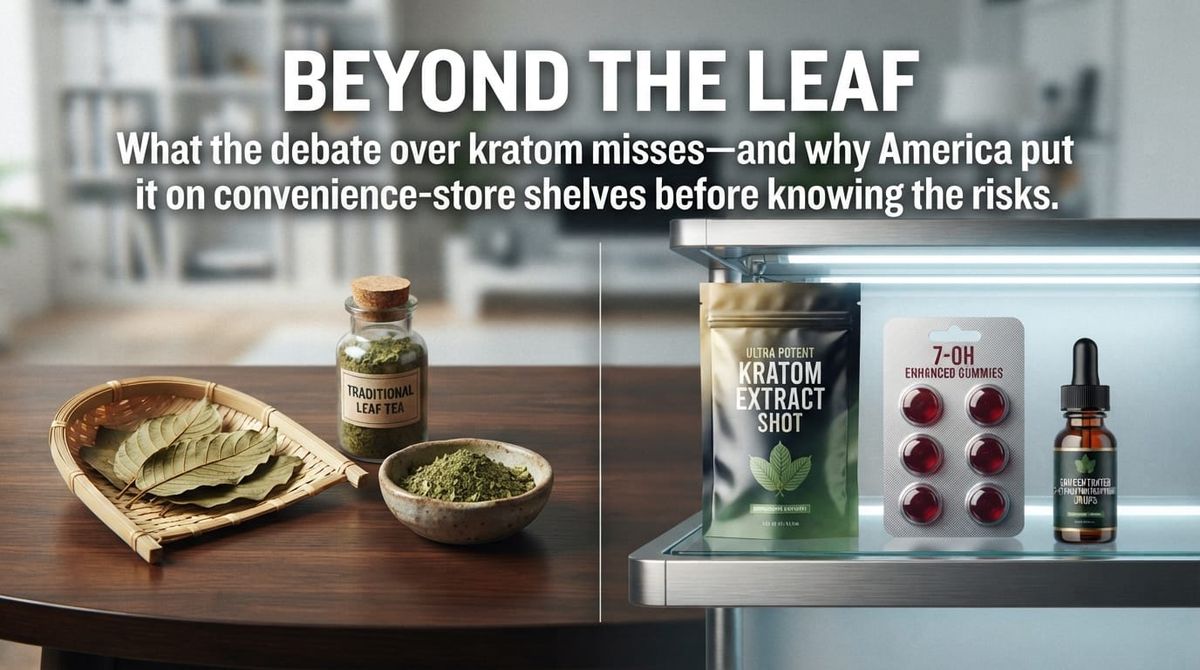
In my earlier article, “The Gas Station Conundrum,” I examined the growing presence of kratom and concentrated 7-OH products on gas-station and convenience-store shelves. Those products have drawn regulatory attention and public-safety concerns. But availability alone does not explain the market. The more important question is why demand exists in the first place.
Many people who buy these products report getting meaningful symptom relief—pain reduction, improved function, or help managing withdrawal—that they were not obtaining, or could not afford to pursue, through a doctor and pharmacy. Perceived efficacy is a primary driver. Price and convenience reinforce the decision: no appointment, no insurance formulary, cash-and-carry access at all hours. For some, the combination of reported benefit and lower friction has made these products a practical alternative to the conventional system.
That alternative is attractive in part because the formal pathway has become expensive and cumbersome for large numbers of Americans. A March 2026 KFF report found that 43 percent of adults changed how they took medication in the previous year because of cost—leaving prescriptions unfilled, cutting doses, or substituting other products. The American prescription process itself adds cost and friction. Before purchasing many medications, a patient must schedule a doctor’s visit, pay for the consultation, and obtain authorization for the pharmacist to dispense the drug. The expense is not only the medicine; it is the price of permission. In other countries, certain medications that require a physician’s prescription in the United States—including erectile-dysfunction drugs, testosterone treatments, common antibiotics, and others—are available far more directly from pharmacies, often with little or no prior doctor involvement. Why must Americans routinely pay for an additional medical consultation to obtain medications that consumers elsewhere can purchase with significantly less barrier?
Pharmaceutical companies have clear economic incentives to protect market share. Regulatory restrictions on alternatives can serve those interests even when safety is the stated rationale. That does not mean every safety concern is invented. Concentrated 7-OH is more potent at opioid receptors than traditional leaf kratom and carries higher risks of dependence and adverse effects. Legitimate public-safety questions exist and should not be dismissed.
Yet safety concerns alone do not capture the full picture. The rise of these gas-station products is also a market signal. When the doctor-and-pharmacy route is too costly, too slow, or too restricted for many people, demand shifts toward whatever is available, affordable, and perceived as effective. Focusing mainly on restricting the workarounds, while leaving the underlying cost and access problems largely unaddressed, treats symptoms rather than causes.
None of this claims that pharmaceutical companies deliberately created the market for kratom or 7-OH. It does, however, raise a systems question that deserves examination:
If Americans are struggling to afford conventional treatment and finding functional relief in lower-cost alternatives sold outside the formal system, are we primarily regulating the products people turn to—or are we also confronting the healthcare structure that is helping generate that demand?
 Michael D. Morrison
About the Author
Mike Morrison is the 2026 PBUS National Bail Agent of the Year, President of the Mississippi Bail Agents Association, and a nationally recognized bail educator, speaker, and criminal justice commentator. With more than 35 years of hands-on experience as a licensed Professional Bail Agent and owner of Mike Morrison Bail Bonding Company in Hattiesburg, Mississippi, he brings a practical, real-world perspective to discussions involving American legal history, institutional accountability, constitutional rights, public safety, technology, and public policy.
Morrison is recognized as a bail trainer by the Mississippi Judicial College and is a sought-after guest speaker for judicial, prosecutorial, and industry conferences across the country. He has presented before state judges, justice court clerks, prosecutors, attorneys general staff, and bail professionals nationwide, and he travels to state bail association conferences to speak on bail and on social media strategy for the profession. He also leads professional education and ethics programs for bail agents through the Master Class Bail Agent Series and other national training initiatives.
At the national level, Morrison works with the Professional Bail Agents of the United States (PBUS) Board of Directors and supports its committees on national initiatives. He also works with the boards of directors of other state bail associations, sharing the strategies behind Mississippi’s successes so they can be put to work across the profession.
He has published nearly 200 articles examining the institutions, policies, and decisions that affect working Americans. His writing is grounded in decades spent inside courtrooms, jails, communities, and the criminal justice system, and his commentary has surpassed 1.75 million views across social media in 2026.
Independent, plain-spoken, and focused on accountability, Morrison writes and speaks about the intersection of government, liberty, public safety, professional responsibility, and the real-world consequences of public policy in Mississippi and across the nation.
© 2026 Mike Morrison. All rights reserved.