Gas Prices, Political Narratives, and the History We Lived
The price at the pump may be today’s story, but the history behind it did not begin in 2026.
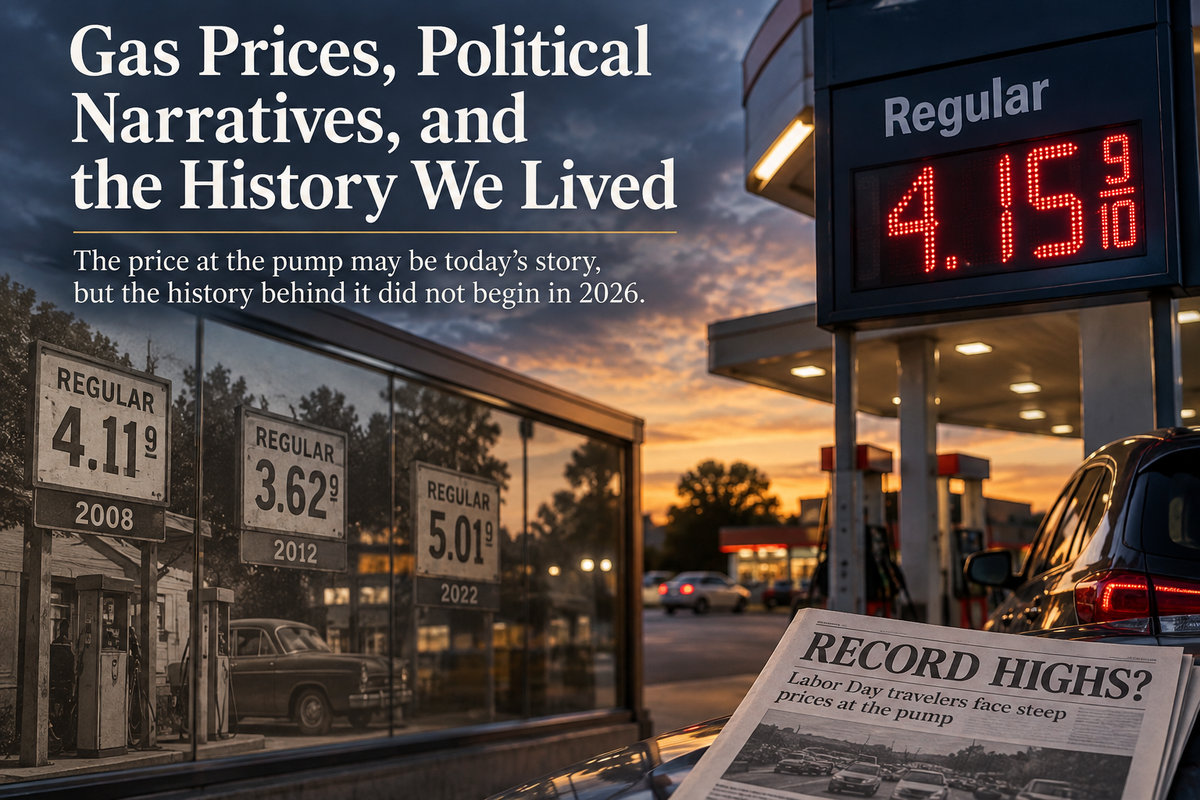
When WTOK carried a report this week under the headline “Gas prices hit record highs,” I had no argument with the fact that gasoline is expensive. At roughly $4.15 a gallon nationally, people are feeling it every time they fill a car, truck, or boat. What caught my attention was the word record, because anyone who has been buying gasoline for the last twenty years knows that America has seen prices at least this painful before.
The explanation is found in the story itself. AAA reported that Labor Day travelers were facing the highest gasoline prices ever for this time of year, with the previous Labor Day record of $3.82 set in 2012. That makes the 2026 price a legitimate Labor Day record, but the headline carries a broader implication than the statistic underneath it. The distinction matters because a reader seeing only “record highs” could reasonably conclude that Americans are paying more for gasoline today than at any point in our history, and that simply is not what the data show.
The historical record is not difficult to find. During the George W. Bush administration, the national average climbed above $4.11 in July 2008. A few years later, during the Obama-Biden years, high gasoline prices became more sustained. In 2011, the national average stayed above $3 throughout the year and averaged about $3.52. The following year, regular gasoline averaged $3.62, setting what was then a national annual record, while crude oil accounted for 66 percent of the retail price. That same 2012 period produced the Labor Day benchmark that stood until this year. These were not isolated numbers on an economic chart; they represented month after month of what Americans were actually paying at the pump.
The country then experienced an even higher level in 2022. During the Biden administration, regular gasoline reached about $5.01 nationally in June and averaged $3.95 for the entire year. That happened only four years ago, which is why the history surrounding today’s headline matters. A $4.15 national average is expensive and deserves to be reported, but it exists inside a much longer history of American gasoline prices rather than standing outside that history as something the country has never experienced.
Gasoline is particularly effective in political storytelling because almost everyone sees the price. It is displayed in enormous numbers beside highways and intersections, and when it rises people do not need an economist to explain the effect on their budget. That visibility makes gasoline an easy political weapon against whichever administration happens to be in office, and it also makes historical context especially important. If today’s price is going to become part of a political discussion, then the prices paid under previous Republican and Democratic administrations belong in that discussion as well. Otherwise, a technically accurate statistic can create a political impression that the historical record does not fully support.
None of that means presidential energy policy is irrelevant. Decisions involving domestic production, regulation, leasing, refining, and other parts of energy policy can affect markets and deserve scrutiny. But the price of gasoline has never been controlled by a single switch in the Oval Office. EIA has repeatedly identified crude-oil prices, refinery conditions, supply and demand, fuel requirements, and international disruptions among the forces influencing what consumers ultimately pay. In 2012, for example, EIA attributed gasoline-price movements to crude prices, refinery outages, grade specifications, and changing supply-and-demand conditions. The political argument may change with each administration, but the underlying petroleum market remains far more complicated than the name of the president printed at the top of a news story.
My concern with the WTOK headline is therefore not that its underlying Labor Day statistic is false; it is that the history necessary to understand that statistic is largely absent from the presentation. There is a meaningful story in Americans paying the highest Labor Day gasoline price on record, and there is nothing wrong with reporting it. But journalism is better when a headline tells readers what the record actually represents rather than leaving a broader political impression that requires the reader to supply the missing history. Many of us can supply it because we lived through those years and paid those prices ourselves.
 Courtney Ann Jackson
ABOUT THE AUTHOR: Mike Morrison is President of the Mississippi Bail Agents Association and the 2026 PBUS National Bail Agent of the Year. With more than 35 years in professional bail and many years working directly with the Mississippi Legislature on bail law, criminal justice policy, and public-safety issues, Morrison has seen firsthand how decisions made by elected officials can strengthen—or weaken—the systems responsible for accountability in Mississippi communities.
His position today is clear: the status quo is no longer acceptable. Anti-bail and anti-accountability policies should not go unanswered simply because they come from an elected office. Sheriffs, supervisors, legislators, prosecutors, judges, and other public officials make decisions that directly affect public safety, court appearance, crime victims, taxpayers, and the ability of the criminal justice system to function as intended. Those decisions deserve scrutiny, and the people making them should expect to be held accountable by the voters they serve.
Under Morrison’s leadership, the Mississippi Bail Agents Association is developing a stronger statewide voice built around education, legislative involvement, public communication, and political awareness. With members and relationships in communities throughout Mississippi, MBAA has both the reach and the responsibility to identify candidates who support public safety and meaningful accountability—and to challenge policies and elected leadership that move Mississippi in the opposite direction.
For Morrison, strengthening professional bail is only part of the objective. The larger responsibility is strengthening public safety across Mississippi by making certain that the people entrusted with public office understand that accountability applies to them as well.