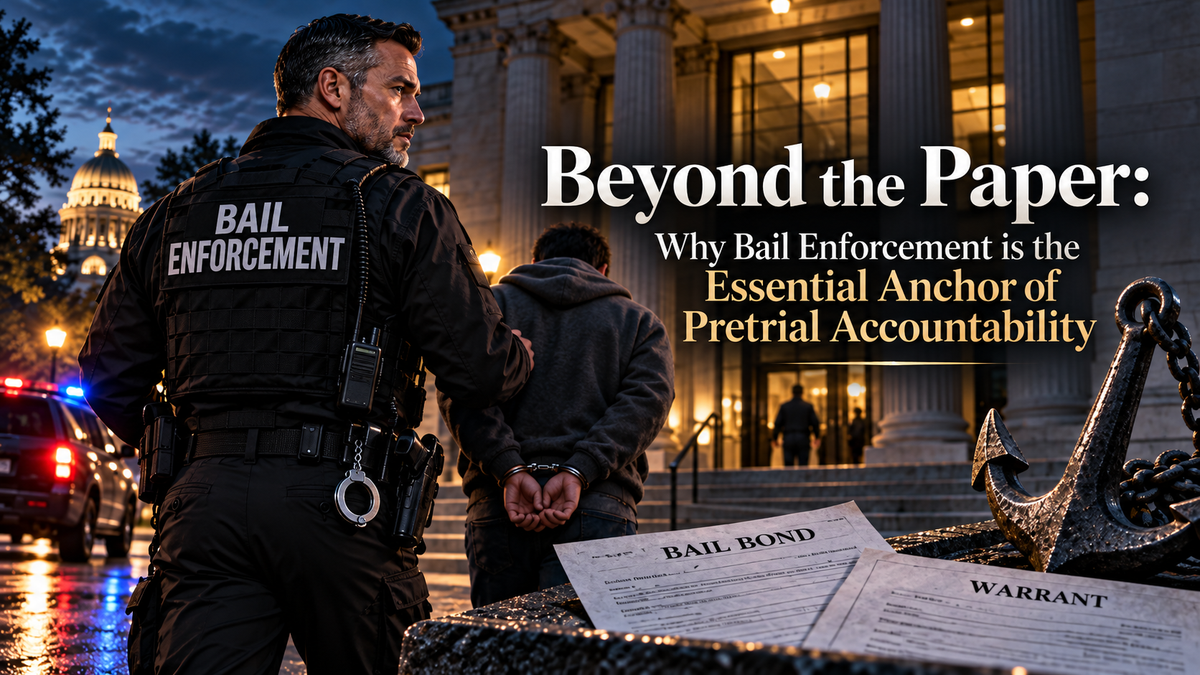
Beyond the Paper: Why Bail Enforcement is the Essential Anchor of Pretrial Accountability
Beyond the Paper: Why Bail Enforcement is the Essential Anchor of Pretrial Accountability How private surety bonds, statutory authority under Mississippi law, and dedicated recovery agents keep the criminal justice system functioning.
Most people understand what happens when a bail bond gets someone out of jail. Very few understand what happens when that person does not come back.
A warrant gives law enforcement the legal authority to arrest. Officers can and do pursue warrants. That authority is real, and it is necessary. What a warrant does not create is a private party with a direct financial interest in that defendant and the statutory authority to actively locate, apprehend, and return that defendant to custody.
A professional surety bond does. When a professional bail agent posts a bond, the surety accepts the financial risk of non-appearance. Mississippi law then supplies the power to act on that risk. Under Section 99-5-27, a bail agent is given broad authority to arrest and transport the principal, authorize another person to do so, obtain assistance from law enforcement, and return the principal to custody. The financial exposure and the statutory authority travel together.
Mississippi does not leave this work to informal guesswork. The Code explicitly defines a Bail Enforcement Agent as someone who assists the professional bail agent in presenting the defendant in court, apprehending and surrendering the defendant, or keeping the defendant under necessary surveillance. You cannot lawfully perform those functions without a license from the Mississippi Department of Insurance.
A Narrow, Specialized Division of Labor
That statutory clarity matters when looking at how the system functions day-to-day. Critics occasionally blur the lines, treating private recovery as an overlap with or distraction from traditional policing.
In reality, it is a clean, efficient division of labor. Law enforcement agencies carry the massive, primary burden of community safety: answering emergency calls, patrolling neighborhoods, investigating violent crime, and managing public order. They do not have the manpower—nor should they—to dedicate specialized units to tracking down every individual who skips out on a municipal or circuit court appearance.
Bail enforcement agents operate on a narrow, contractually bound mandate. They do not investigate unrelated crimes or handle general public safety duties. Their legal authority is strictly tied to the principal named on the bond. By taking responsibility for that specific defendant, the private side absorbs a logistical workload that would otherwise fall squarely onto overextended sheriff’s departments and police forces.
The Taxpayer Protection Principle
We often hear abstract claims about how professional surety bail benefits the public treasury, but the proof is written directly into state law.
The professional surety system maintains a private recovery capability without requiring taxpayers to finance that recovery operation as another government program. Section 99-5-27 provides a concrete example of this statutory protection: when the Hold Order provisions of Section 99-5-27 apply, the financial responsibility for returning that defendant does not simply fall on the county. Mississippi law places that responsibility directly on the bail agent, requiring them to either personally return the principal at no cost to the county or reimburse the county’s reasonable return costs when only law enforcement can take custody.
The taxpayer is protected by design. The public does not fund the agent’s equipment, travel, or surveillance operations, and local budgets are shielded from bearing the full burden of multi-jurisdictional returns.
Turning a Promise into Reality
Without the enforcement side, a bond is a financial promise that sits on paper.
When a defendant fails to appear, the court process can be delayed, warrants remain outstanding, and victims may be left waiting longer for resolution. Enforcement is what turns financial accountability into actual return-to-court accountability. It provides a dedicated party with a direct financial stake and state-backed authority to produce the defendant so the wheels of justice can keep turning.
That is the institutional role bail enforcement plays, and it is why the function remains critical to the integrity of the entire system.
About the Author
Mike Morrison is the 2026 PBUS National Bail Agent of the Year, President of the Mississippi Bail Agents Association, and a nationally recognized bail educator, speaker, and criminal justice commentator. With more than 35 years of hands-on experience as a licensed Professional Bail Agent and owner of Mike Morrison Bail Bonding Company in Hattiesburg, Mississippi, he brings a practical, real-world perspective to discussions involving American legal history, institutional accountability, constitutional rights, public safety, technology, and public policy.
Morrison is recognized as a bail trainer by the Mississippi Judicial College and is a sought-after guest speaker for judicial, prosecutorial, and industry conferences across the country. He has presented before state judges, justice court clerks, prosecutors, attorneys general staff, and bail professionals nationwide. He also leads professional education and ethics programs for bail agents through the Master Class Bail Agent Series and other national training initiatives.
He has published nearly 200 articles examining the institutions, policies, and decisions that affect working Americans. His writing is grounded in decades spent inside courtrooms, jails, communities, and the criminal justice system, and his commentary has reached more than one million views across social media in 2026.
Independent, plain-spoken, and focused on accountability, Morrison writes and speaks about the intersection of government, liberty, public safety, professional responsibility, and the real-world consequences of public policy in Mississippi and across the nation.
© 2026 Mike Morrison. All rights reserved.