Bail Agents Do More than Write Bonds
Bail bonds protect the presumption of innocence and allow defendants to continue working, supporting their families, and preparing their defense while their case is pending. Without this system, defendants who have not been convicted of anything could remain in jail simply because they cannot afford to pay the full amount of their bail in cash.
Professional surety bail shifts financial risk away from taxpayers. The bail agent and surety assume the financial obligation of the bond rather than requiring government to create, staff, equip, and operate another taxpayer-funded pretrial supervision system.
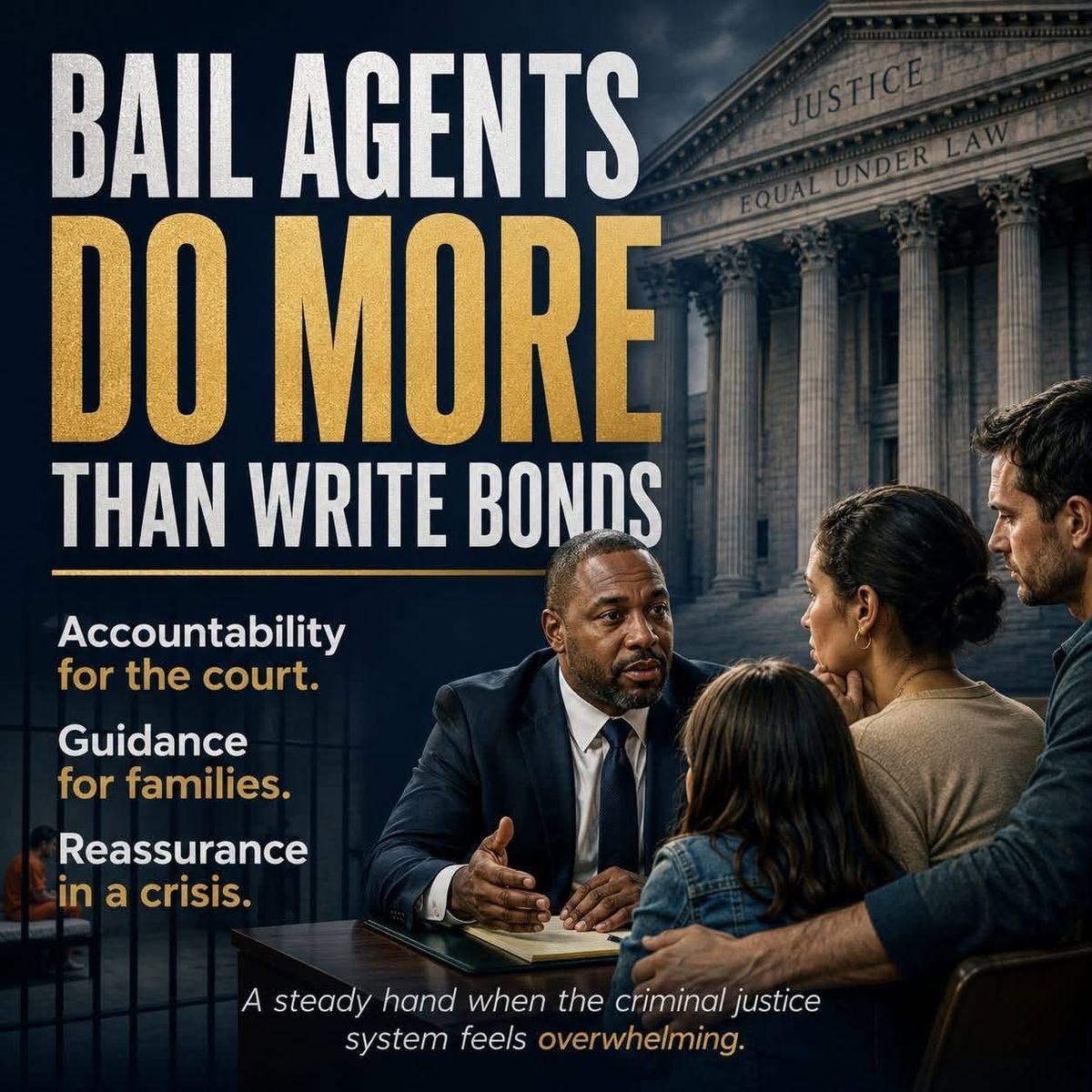
The system also provides direct accountability to the court. The bail agent has a financial and professional interest in the defendant’s appearance. If the defendant fails to appear, the agent has both the authority and the responsibility to locate and return that person to the court’s jurisdiction.
Just as importantly, professional bail agents help families navigate one of the most unfamiliar experiences of their lives. Families often ask: Do we need an attorney? Where do we go for court? How should the defendant dress? What happens next? These are frequently the first questions a family has ever had to ask about the justice system.
A professional bail agent can explain the general process, encourage the family to seek qualified legal counsel, answer practical questions, and serve as a reliable point of contact when the family may not know where else to turn. That service begins with the first telephone call—not simply when the bond is written.
The work continues after release. Court dates can change, indictments can be returned, reporting requirements can be imposed, and contact information must remain current. The bail agent stays connected to the defendant throughout the life of the bond, helping ensure important notices and obligations are not ignored or overlooked.
A bail agent is more than someone who posts a bond. Families remember who answered the phone, who explained what was happening, and who remained available after the defendant walked out of jail.
About the Author
Mike Morrison is the 2026 PBUS National Bail Agent of the Year and President of the Mississippi Bail Agents Association. With more than 35 years of hands-on experience as a licensed bail agent and owner of Mike Morrison Bail Bonding Company in Hattiesburg, Mississippi, he brings a practical, real-world perspective to his writing on criminal justice, constitutional rights, public safety, government accountability, taxation, technology, and public policy.
Morrison has published nearly 200 articles examining the decisions, institutions, and policies that affect working Americans. His writing is grounded in experience rather than theory, drawing from decades spent in courtrooms, jails, communities, and the criminal justice system. His commentary has earned more than one million views across social media in 2026 alone.
He regularly presents on bail policy and professional standards at the Mississippi Judicial College and leads ethics and training programs for bail professionals nationwide.
Independent, plain-spoken, and focused on accountability, Mike writes about the intersection of government, liberty, public safety, and the real-world consequences of policy decisions on Mississippi families and the nation.
© 2026 Mike Morrison. All rights reserved.