Advocacy Journalism and the Distortion of Civic Discourse
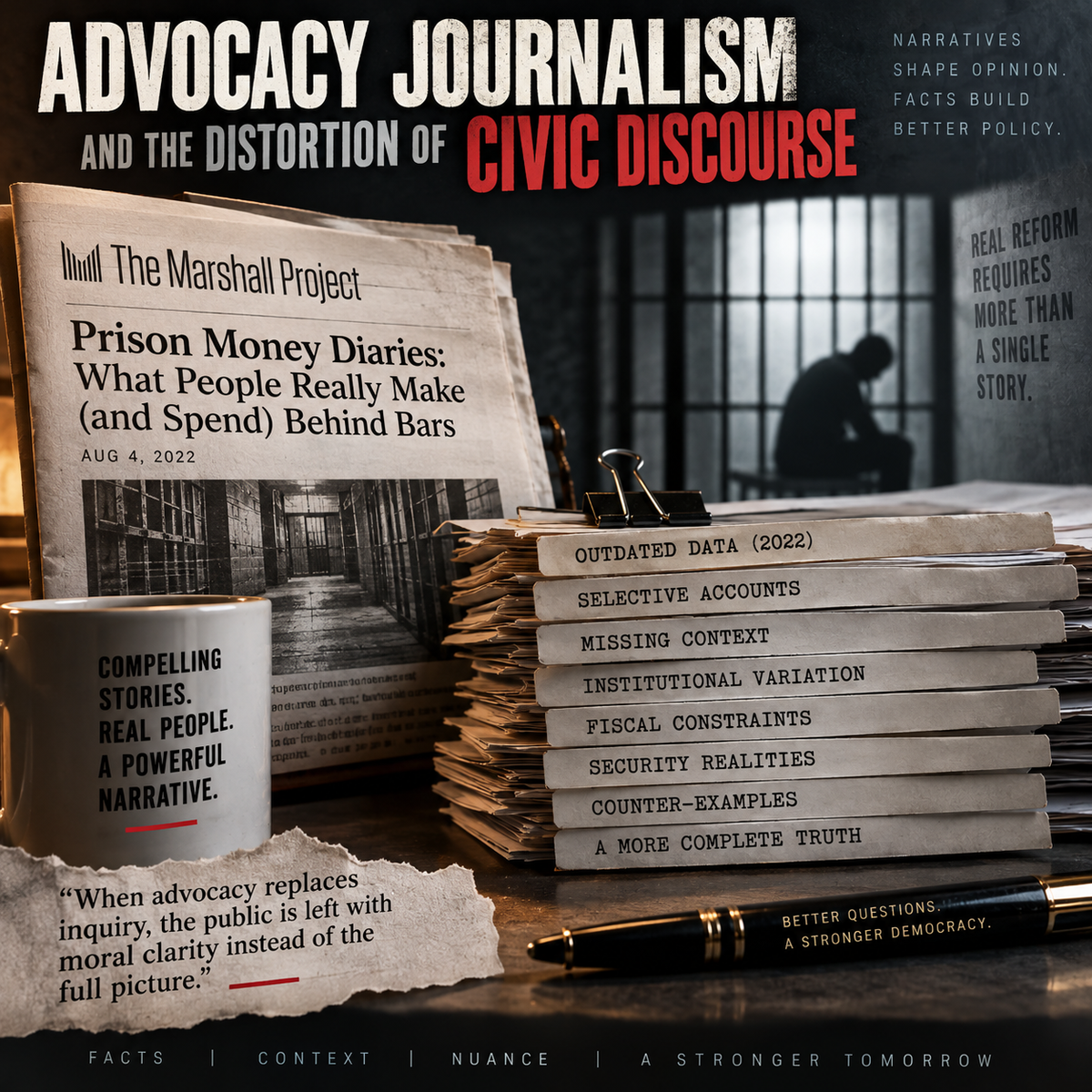
The continued circulation of pieces like The Marshall Project’s 2022 article “Prison Money Diaries: What People Really Make (and Spend) Behind Bars” reveals a deeper problem in contemporary public-policy debate: the point at which advocacy journalism crosses from investigation into narrative management. When a publication presents itself as offering an empirical window into daily prison life—“what people really make and spend”—while resting on a static 2022 quantitative baseline and a hand-selected set of personal accounts, it erodes the factual common ground required for serious reform discussions.
The method is straightforward. The article’s central wage claim (average prison pay “maxes out at 52 cents per hour”) is taken from the ACLU’s June 2022 Captive Labor report. Those figures have not been refreshed with new national data. Instead, they are paired with diaries and interviews drawn from a convenience sample of longer-term prisoners, many serving sentences for serious crimes, who describe acute scarcity and elaborate informal economies. The result is a portrait of near-universal deprivation that feels current and comprehensive. A rigorous investigation would test that portrait against institutional variation, differing state systems, facility security levels, family support patterns, and the operational realities of running large correctional systems. This piece does not. Data and anecdote function mainly as illustration for a framing already in place.
When advocacy networks treat public discourse as a sustained campaign—recycling the same dated statistics, amplifying the most emotionally resonant stories, and citing one another until repetition itself begins to look like independent confirmation—they crowd out the harder work of balanced scrutiny. Nuance, counter-examples, fiscal constraints, and security trade-offs become liabilities rather than necessary elements of the truth. The public is left with manufactured moral clarity instead of the complicated picture required for workable policy.
Honest public-policy commentary demands a commitment to the whole record: the documented low wages and high commissary costs and the variation across systems, the budget pressures on states, and the practical difficulties of managing large incarcerated populations. Substituting selective, frozen evidence for that fuller accounting is not neutral journalism. It is a structural distortion that weakens the shared factual baseline on which genuine institutional reform depends.
 Beth Schwartzapfel
About the Author
Mike Morrison is the 2026 PBUS National Bail Agent of the Year, President of the Mississippi Bail Agents Association, and a nationally recognized bail educator, speaker, and criminal justice commentator. With more than 35 years of hands-on experience as a licensed Professional Bail Agent and owner of Mike Morrison Bail Bonding Company in Hattiesburg, Mississippi, he brings a practical, real-world perspective to discussions involving bail, criminal justice, constitutional rights, public safety, government accountability, technology, and public policy.
Morrison is recognized as a bail trainer by the Mississippi Judicial College and has been invited to present before judges, justice court clerks, prosecutors, bail professionals, and other criminal justice stakeholders, including as a guest speaker for the Mississippi Attorney General’s Office. He also leads professional education and ethics programs for bail agents across the country through the Master Class Bail Agent Series and other national training initiatives.
He has published nearly 200 articles examining the institutions, policies, and decisions that affect working Americans. His writing is grounded in decades spent inside courtrooms, jails, communities, and the criminal justice system, and his commentary has reached more than one million views across social media in 2026.
Independent, plain-spoken, and focused on accountability, Morrison writes and speaks about the intersection of government, liberty, public safety, professional responsibility, and the real-world consequences of public policy in Mississippi and across the nation.
© 2026 Mike Morrison. All rights reserved.