The Haystack Doctrine
A federal judge just ruled the government cannot vacuum up everyone's phone data to find one suspect. It is not an isolated ruling. It is the same pattern I wrote about earlier this week when traffic cameras sold as convenience quietly became warrant-free bulk surveillance networks. Once again, government is reaching past constitutional limits in the name of public safety.
U.S. District Judge Carlton Reeves ruled this week that "tower dump" warrants violate the Fourth Amendment. Not narrowly. Not on the facts of one case. He declared them per se unconstitutional, meaning no version of this warrant, written by anyone, for any purpose, can satisfy the Constitution as it currently exists. That is about as hard a line as a federal judge can draw, and it deserves more attention than a few news cycles.
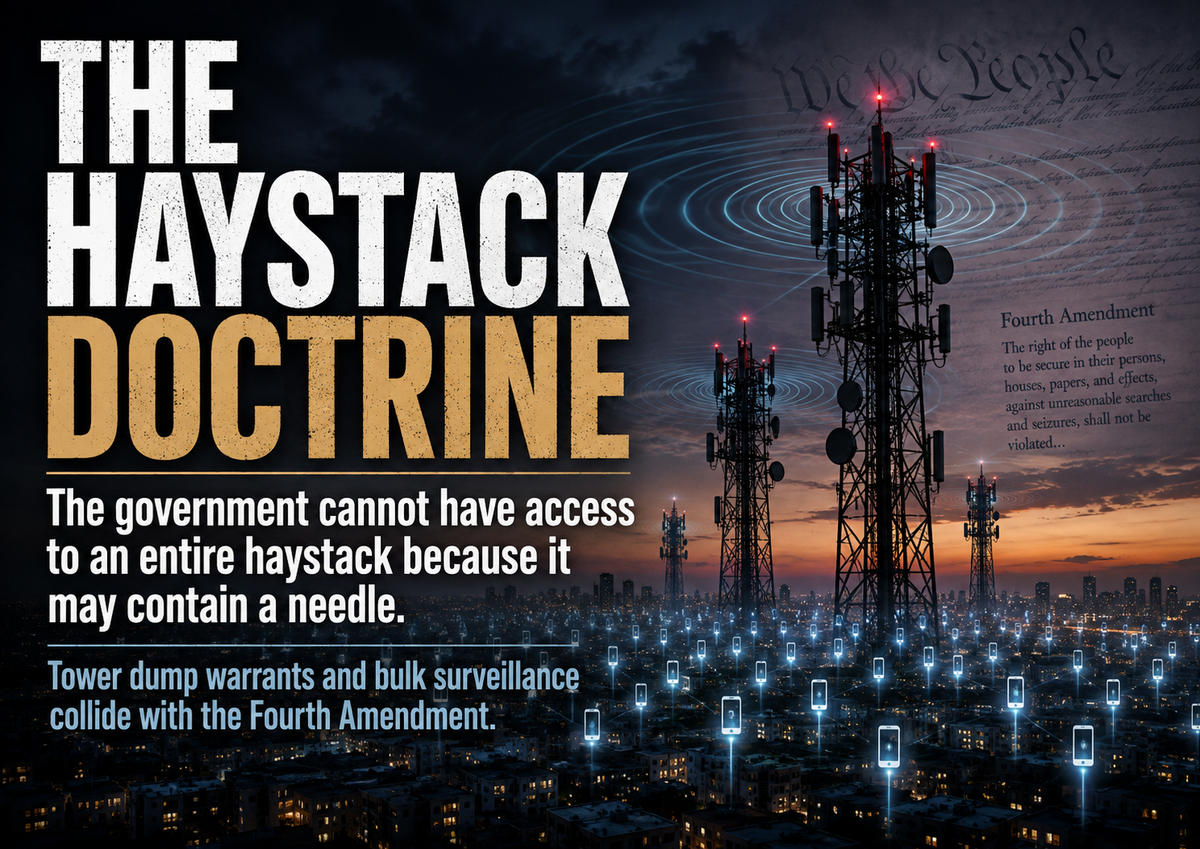
Here is what a tower dump actually is. When investigators want to know who was near a crime scene, they can ask a cell provider for every device that connected to a specific tower during a chosen window of time. That sounds targeted until you realize what "every device" means in practice. It means the delivery driver who happened to be on that street. It means the woman leaving a doctor's appointment two blocks away. It means every person who worships, worked, or simply lived within range of that tower, whether they had anything to do with the crime or not. The government is not asking for a suspect's location. It is asking for a map of everyone.
That is precisely the problem Reeves identified. The case grew out of a federal investigation into gang-related violence in Jackson, where prosecutors sought tower dump data tied to nine separate locations. A magistrate judge turned down those applications twice, and Reeves upheld both denials, writing that "the government cannot have access to an entire haystack because it may contain a needle." He went further, noting that a single tower dump can produce location records on hundreds of thousands of individual devices, exposing where people were standing outside hospitals, churches, and their own homes. As he put it, the technology now gives the government "the capacity to identify any individual with a cell phone, at any public or private location." Read that sentence twice. That is not a description of a narrow investigative tool. That is a description of a surveillance capability the Founders never could have imagined and would never have tolerated.
This ruling did not appear out of nowhere. It builds directly on a line of cases that has been tightening the leash on digital surveillance for years. In Carpenter v. United States, the Supreme Court held in 2018 that police need a warrant to obtain historical cell-site records. In 2024, the Fifth Circuit ruled that geofence warrants, which work the same way in reverse, are also unconstitutional. And just this past June, the Supreme Court ruled 6-3 in Chatrie v. United States that pulling someone's location through a geofence warrant counts as a search under the Fourth Amendment, a decision Reeves leaned on heavily. Put those rulings side by side and a pattern emerges. Courts are steadily rejecting the idea that convenience justifies scale, and that a warrant can be broad as long as it is eventually narrowed by the government's own discretion.
But the pattern that matters most here is not the one in the case law. It is the pattern in the conduct that keeps landing in front of judges in the first place. This is not an isolated overreach by one agency chasing one gang investigation in Jackson. It is the same pattern visible in the cameras hanging over our intersections—technology sold for traffic management that became a searchable record of ordinary people's movements. Local police departments, state agencies, and federal investigators are, on a daily basis, reaching past the limits the Constitution puts on them, and they are doing it under the same justification every time: public safety. That word gets used as though it were a permission slip. It is not. The Fourth Amendment was written precisely because government will always have a public safety argument for wanting more access, more data, and fewer restrictions. The Founders heard that argument too, and they wrote the amendment anyway.
Here is the part that should trouble people more than the ruling itself. A government that treats constitutional limits as optional whenever it can invoke public safety is not protecting public safety. It is undermining it. Public safety depends on public trust, and public trust depends on people believing that government power has real limits, enforced consistently, not limits that dissolve the moment an agency decides the cause is important enough. Every tower dump, every geofence warrant, every camera network quietly turned into a bulk-collection system chips away at that trust. When citizens stop believing their rights are respected by the very government sworn to protect them, that is not a technicality. That is a public safety problem in its own right, and it is the one nobody in these cases wants to talk about.
The Founders banned general warrants in 1791 for exactly this reason. They had lived under British "writs of assistance" that let officers search broadly on the theory that guilt might turn up somewhere. They wrote the Fourth Amendment specifically to kill that theory, and it took two centuries and a supercomputer in every pocket to test whether the principle would hold. This week, in the Southern District of Mississippi, it held.
The ruling is binding for now only in that district, and it remains to be seen whether the government appeals. But this case should not be read as one court correcting one warrant application. It should be read as one more entry in a growing record of local, state, and federal government reaching past constitutional limits and calling it public safety. The government cannot have access to an entire haystack because it may contain a needle. That principle does not stop at cell towers—and it does not stop at the cameras over our intersections either. It should not have taken this long for a court to say so.
 WALA Staff
About the Author
Mike Morrison is the 2026 PBUS National Bail Agent of the Year and President of the Mississippi Bail Agents Association. With more than 35 years of hands-on experience as a licensed bail agent and owner of Mike Morrison Bail Bonding Company in Hattiesburg, Mississippi, he brings a practical, real-world perspective to his writing on criminal justice, constitutional rights, public safety, government accountability, taxation, technology, and public policy.
Morrison has published nearly 200 articles examining the decisions, institutions, and policies that affect working Americans. His writing is grounded in experience rather than theory, drawing from decades spent in courtrooms, jails, communities, and the criminal justice system. His commentary has earned more than one million views across social media in 2026 alone.
He regularly presents on bail policy and professional standards at the Mississippi Judicial College and leads ethics and training programs for bail professionals nationwide.
Independent, plain-spoken, and focused on accountability, Mike writes about the intersection of government, liberty, public safety, and the real-world consequences of policy decisions on Mississippi families and the nation.
© 2026 Mike Morrison. All rights reserved.