Should Circuit Courtrooms Be Televised or Livestreamed?
Circuit courts handle some of the government’s most consequential daily work. People are jailed or released on bond. Cases are dismissed, continued, negotiated, tried, or resolved. Sentences are imposed. Victims, defendants, witnesses, families, prosecutors, defense lawyers, judges, clerks, and law enforcement all pass through those rooms. Much of this is done in the public’s name and at public expense. Yet relatively few citizens ever see how it actually operates day to day.
Most public understanding of the criminal justice system comes from news coverage, social media, political messaging, or the rare high-profile case. That leaves a gap. Voters are asked to evaluate elected judges, prosecutors, and other justice-system officials, but almost none of them watch those officials do the ordinary job. A standing, controlled visual record of public proceedings would let people observe docket management, how bond is handled, how often cases are continued, how defendants and victims are treated, and how sentencing decisions are explained.
Cameras can also improve accountability and accuracy. When disputes later arise about what was said or how someone was treated, a complete recording is usually clearer than competing memories. In an era of rapid misinformation, official livestreams or recordings can reduce reliance on second-hand or selectively edited accounts.
Those are the strongest arguments for greater access.
There are also serious, legitimate counter-arguments that cannot be waved away.
Criminal courts deal with people in crisis, unconvicted defendants, victims, witnesses, and sensitive information. Broadcasting can expose individuals to unwanted attention, harassment, or lasting online permanence. Jurors should not become public figures. Minors, sexual-assault victims, confidential informants, undercover officers, and other vulnerable witnesses often have compelling reasons not to appear on camera. Fixed internet distribution multiplies the risk: a few seconds clipped from a longer hearing can create a false impression that travels far and never fully disappears.
There is also the concern that cameras change behavior. Courtrooms function best when participants focus on the case rather than on how a moment will look online or on television. Grandstanding by lawyers, self-conscious witnesses, or judges mindful of public reaction are real risks, even if studies and experience in many state courts have found the effects smaller than feared in most routine matters.
None of these concerns requires a total ban. They do require rules.
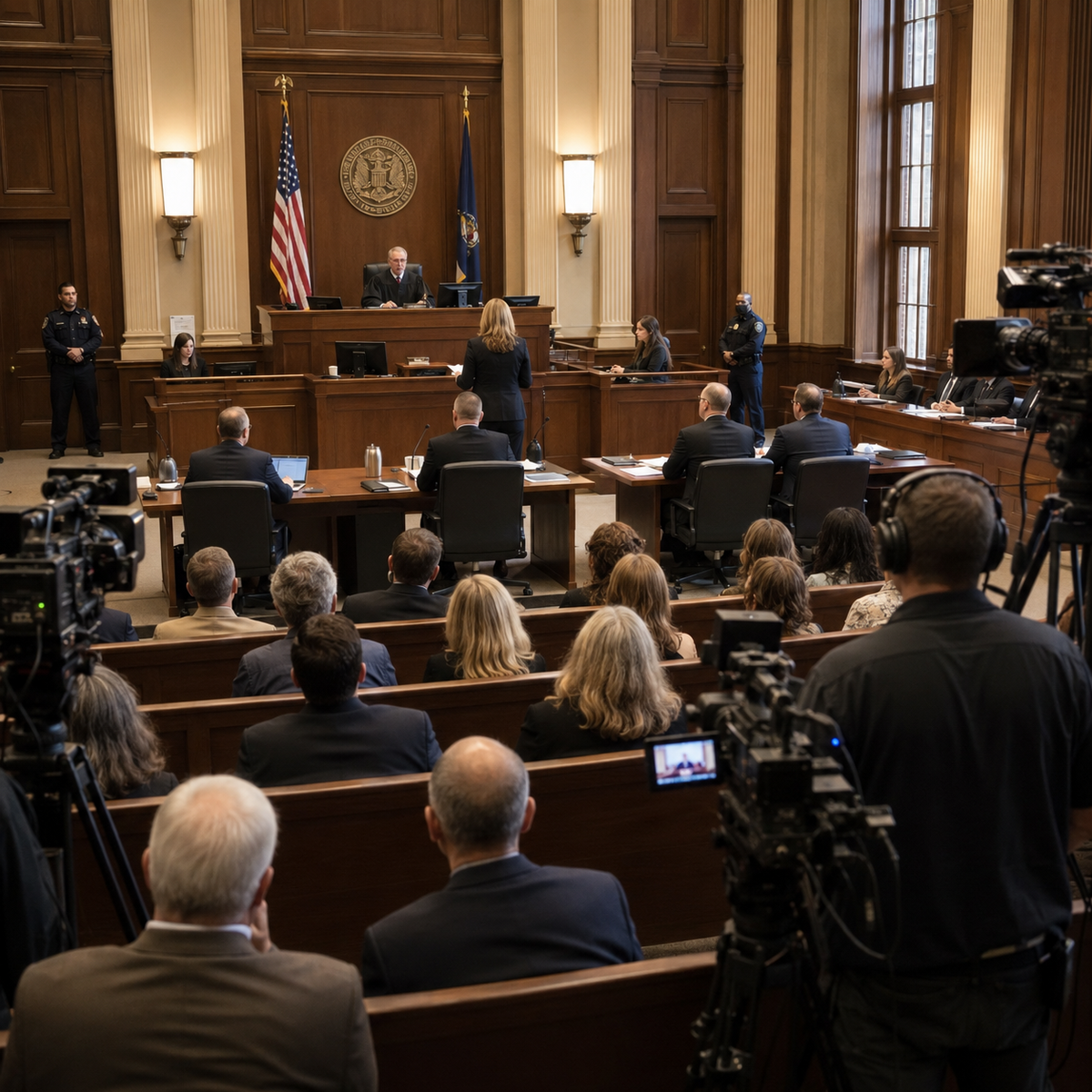
Modern practice already points toward a workable middle path used in many states: court-controlled cameras or livestreams of public proceedings as the default, with clear authority for the judge to restrict or pause coverage to protect jurors, witnesses, minors, confidential information, or a defendant’s fair-trial rights. Faces of jurors can be kept off camera. Certain categories of cases (juvenile, sensitive family matters, certain victim testimony) can remain off-limits or heavily restricted by rule. Official feeds reduce the incentive for outsiders to smuggle in phones and create uncontrolled recordings. The technology exists to make coverage less intrusive than the old media-circus model.
The real policy choice is not “every second of every case broadcast without limits” versus “keep the public largely outside.” It is whether the public that funds the system and elects many of its key operators should have substantially greater ability to observe the ordinary, day-to-day exercise of that power—subject to the same privacy and fairness constraints that already limit physical public access in sensitive situations.
Open justice has long been a core principle. Physical courtroom doors are already open in most proceedings. The practical question in 2026 is how far that principle should extend when nearly everyone carries a camera and distribution is instantaneous. A default of controlled, court-managed visual access for public circuit-court business, with robust judicial discretion to protect people and the integrity of the process, is a coherent way to honor both transparency and the real human stakes inside those rooms.