Refusing to Evolve
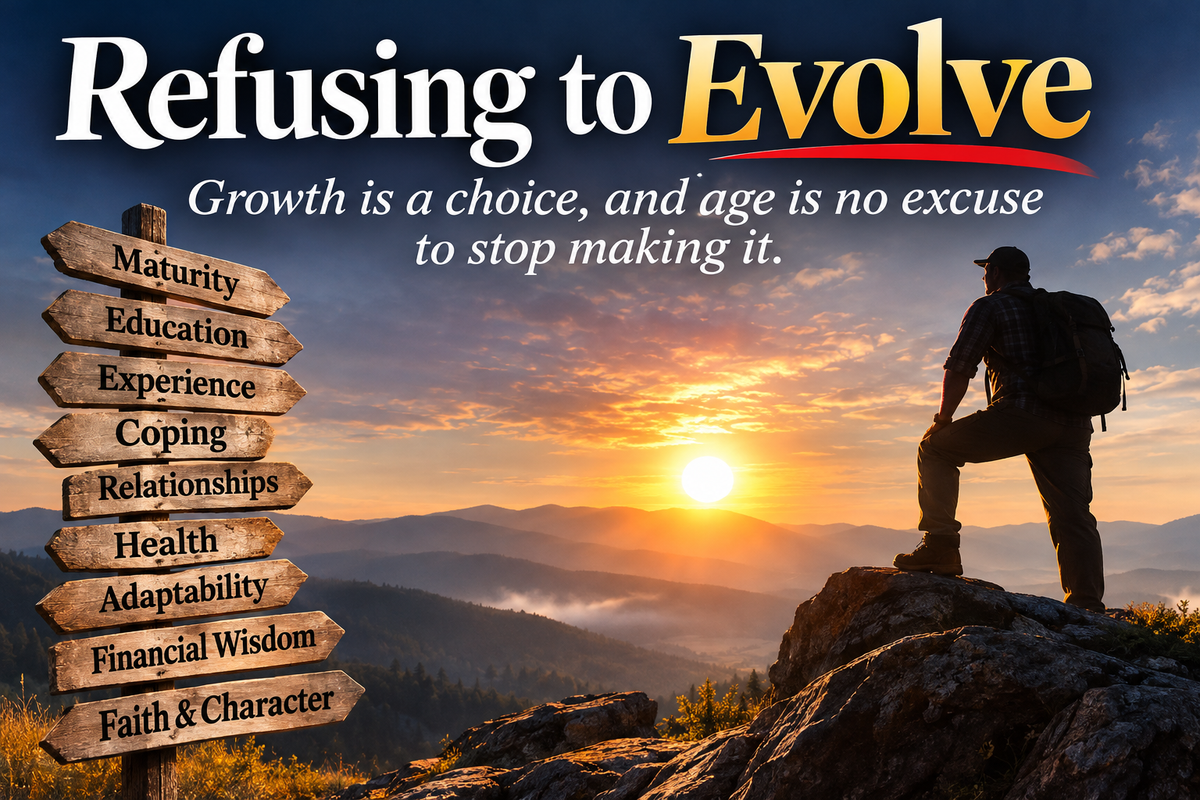
Growth is a choice, and age is no excuse to stop making it
There is a quiet problem in a lot of people’s lives, and it does not show up on a pay stub or a report card. It is the refusal to evolve. Each one of us should be growing at multiple levels throughout our lives — in maturity, in education, in experience, and in how we cope with what life puts in front of us. Growth is not a season that ends when we finish school or settle into a job. It should continue for as long as we are breathing.
Age should not be a factor in growth. Yet if you sit back and watch from a safe distance, you will see people who are the same today as they were ten or twenty years ago. The same habits, the same complaints, the same way of handling disappointment and the same reaction when someone tells them something they do not want to hear. They are not evolving, and more troubling, they show no motivation to. Somewhere along the way they decided that who they were was good enough, and they stopped working on who they could become.
For many people, the growth they do chase as they get older is measured in income and job position. They want the raise, the promotion, the better title, and those are honorable goals. Providing for a family and building a career take real effort. But a raise does not make someone more mature, and a title does not teach someone how to handle conflict. A person can climb every rung of the ladder and still be the same person at the top that they were at the bottom. Income and position are results. They are not the same thing as growth.
Real growth happens in places a paycheck cannot reach. Maturity is learning to respond instead of react, to own our mistakes instead of explaining them away. Education does not end with a diploma; the people who keep reading, keep asking questions and keep learning new skills are the ones who stay useful in a world that does not stand still. Experience only counts if we learn from it, because twenty years of experience can just as easily be one year repeated twenty times. And coping — how we handle loss, stress, setbacks and change — may be the clearest measure of all. Life will test every one of us, and how we carry ourselves through those tests says more about our growth than anything we own.
One of the most important lessons of growth is learning to get along with others. Maturity shows itself most clearly in how we treat people, especially the ones we disagree with. Some people go through life in constant conflict with neighbors, coworkers, family and anyone who sees things differently, and they never stop to ask what part they play in it. Growing means learning to listen as well as we talk, to let the small things go, and to understand that we do not have to win every argument to live in peace. Existing without conflict is not weakness. It is a skill, and it takes years to develop. I live with wild animals all around my home, and in my eyes it is a success that I have made my place there without disrupting theirs. They go about their lives and I go about mine, and the land has room for both of us. People could learn a great deal from that. We do not have to control everyone around us or prove ourselves right to them. Sometimes the clearest sign of growth is the ability to share space peacefully and leave things no worse than we found them.
There are other areas worth an honest look. Our health is one, because the choices we make about our bodies at forty and fifty shape the life we have at seventy. Our relationships either deepen with time or wear thin from neglect. Our willingness to adapt matters, whether that means new technology, new ways of doing business, or simply accepting that the way we have always done something may not be the best way anymore. Our understanding of money matters too, which is different from how much of it we earn. And for many of us, our faith and character — who we are when no one is watching — should be growing right alongside everything else.
So why do so many people stop? Comfort is a big part of it. Growth is uncomfortable, and staying the same feels safe even when it is not. Pride plays a role, because admitting there is room to grow means admitting we have not arrived. And fear holds people back, fear of failing, fear of looking foolish, fear of finding out that change is harder than they hoped. None of those reasons are unusual, but none of them are good enough to justify standing still for the rest of our lives.
Evolving does not mean becoming someone else. It means becoming more of who we were meant to be. The question each of us should ask is not how old we are or how much we make, but whether we are still growing. If the honest answer is no, there is still time to change that.
About the Author
Mike Morrison is the 2026 PBUS National Bail Agent of the Year, President of the Mississippi Bail Agents Association, and a nationally recognized bail educator, speaker, and criminal justice commentator. With more than 35 years of hands-on experience as a licensed Professional Bail Agent and owner of Mike Morrison Bail Bonding Company in Hattiesburg, Mississippi, he brings a practical, real-world perspective to discussions involving American legal history, institutional accountability, constitutional rights, public safety, technology, and public policy.
Morrison is recognized as a bail trainer by the Mississippi Judicial College and is a sought-after guest speaker for judicial, prosecutorial, and industry conferences across the country. He has presented before state judges, justice court clerks, prosecutors, attorneys general staff, and bail professionals nationwide, and he travels to state bail association conferences to speak on bail and on social media strategy for the profession. He also leads professional education and ethics programs for bail agents through the Master Class Bail Agent Series and other national training initiatives.
At the national level, Morrison works with the Professional Bail Agents of the United States (PBUS) Board of Directors and supports its committees on national initiatives. He also works with the boards of directors of other state bail associations, sharing the strategies behind Mississippi’s successes so they can be put to work across the profession.
He has published nearly 200 articles examining the institutions, policies, and decisions that affect working Americans. His writing is grounded in decades spent inside courtrooms, jails, communities, and the criminal justice system, and his commentary has surpassed 1.9 million views across social media in 2026.
Independent, plain-spoken, and focused on accountability, Morrison writes and speaks about the intersection of government, liberty, public safety, professional responsibility, and the real-world consequences of public policy in Mississippi and across the nation.
© 2026 Mike Morrison. All rights reserved.