Master Class: Professional Discretion for Bail Agents
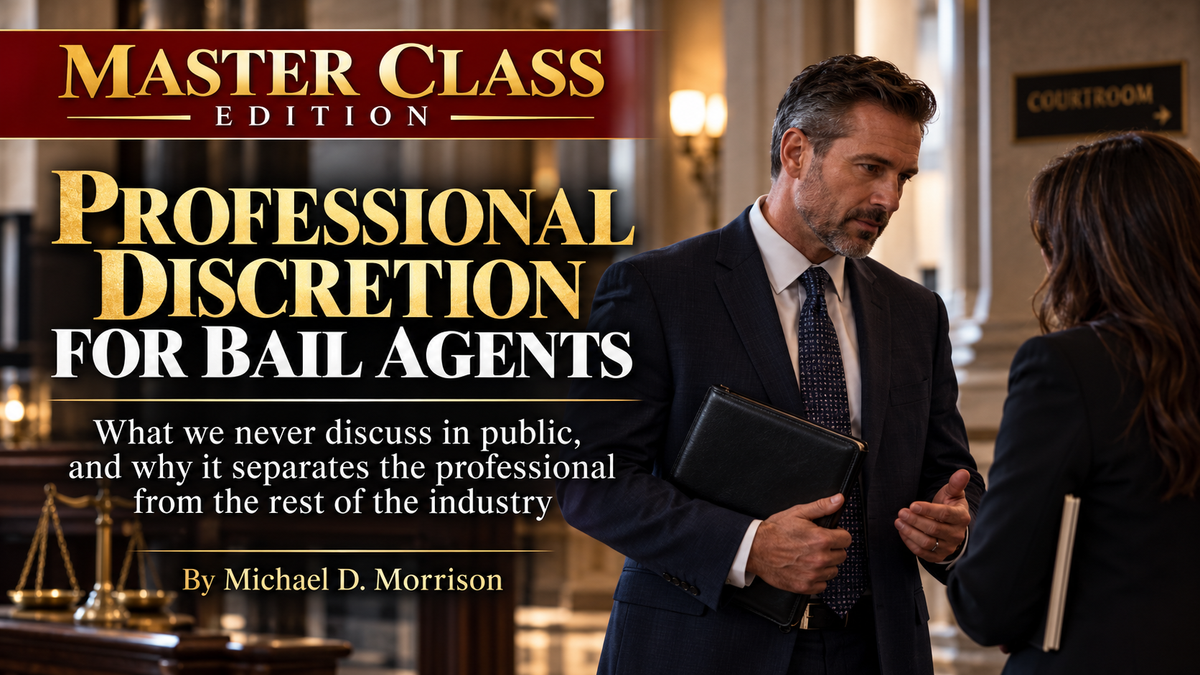
What we never discuss in public, and why it separates the professional from the rest of the industry.
Bail agents spend more time in public than most professionals. We are in courthouse hallways, jail lobbies, restaurants near the courthouse, churches, ball games, and on social media, and every one of those places has an audience. Public conversation is never neutral. What we say either builds trust in our agencies and our profession or wears it down. The standard a Master Class Bail Agent applies is not whether something is legal to say, because plenty of legal things damage a business and a profession. The standard is whether it raises the standing of our profession or lowers it.
This module deals with what a bail agent must not say in public. It builds on We Carry a State License. Do We Look Like It?, because appearance makes the first impression and conversation makes the second. Our profession has been weakened by careless talk as much as by anything said against us, and what we say is entirely within our control.
The first topic that stays out of public conversation is money. What you charge, what you made on a bond, the collateral you are holding, and what a client still owes you are private business matters. Discussed over lunch, they reduce the profession to a transaction and invite the listener to see a bail agent as someone profiting from another family’s worst day. They also invite comparison shopping on the spot. When a family member at a ball game asks what you charge on a $50,000 bond, the professional answer is that every situation is different and you would be glad to sit down with them at the office. A family deserves to have the cost of a bond explained properly, with the paperwork in front of them, not across a table where others are listening. What a client owes you is that client’s business and yours, and no one else’s.
The second is war stories. “This one time I wrote a bail bond” may feel like a good story to tell, but it does nothing for the profession’s image. Chase stories, fight stories, and dramatic recoveries tell the public, and the families who may call us next, that bail agents thrive on conflict. Fugitive recovery details carry added risk. How you found someone, where you picked them up, and what it took to bring them in can identify a client, reveal methods, and put people in danger. A successful recovery is quiet professional work. The agents who need to tell those stories are usually still proving something. The ones who don’t have already proven it.
The third is our clients. Who you bonded out, their charges, and their family situation do not belong in public. People are listening, and someone at the next table may know them. In a Mississippi town of any size, even a few details without a name can tell a listener exactly who you mean. A family that trusted us with their loved one’s release trusted us with their privacy as well. The same is true of what defendants are accused of. “You won’t believe what this guy was arrested for” makes us sound like gossips, not professionals, and it forgets that every person we bond is presumed innocent.
The fourth is forfeitures and losses. Every bail agent who has written bonds long enough has had a defendant miss court and returning that defendant to court is part of the responsibility we accept when we sign the bond. That work is not a topic for lunch. Talking in public about bonds you lost or a skip you are chasing leaves the listener with an incomplete picture of our profession, one that leaves out the defendants who appear every day and the work it takes to return those who do not. When our results are discussed in public, they should be discussed in full and with the facts.
The fifth is the courts and the people we work alongside. Complaints about judges, clerks, or how a court handles bonds belong in association meetings and with legislators, not in a restaurant or a lobby. The court system is where we work every day, and public venting damages the relationships that make that work possible. It also casts the agent as an adversary rather than a professional participant. The same holds for the law enforcement officers and jail staff we depend on. A complaint made at the jail window travels faster than the bond paperwork. None of this means problems go unaddressed. When a court refuses professional surety bonds or fails to follow the forfeiture statutes, the professional response is organized, factual, and made through the right channels: the association, the legislature, and published, documented work. There is a difference between advocacy and venting. One changes things. The other only costs us.
The sixth is our own profession. Running down a competitor in public lowers everyone’s standing, not just theirs. The public does not separate one bail agent from another. It hears “bail agents.” Internal disagreements within an association, and conflicts between bail groups, belong inside the profession where they can be worked out. Aired in public, they hand the opponents of surety bail the story of a divided profession.
I have said this at bail conferences across the United States, and it bears repeating here. As adults, we will disagree. It is how we address those disagreements that is critical. Never make a disagreement personal and never lose your temper. We are going to disagree from time to time, and when we do, it is time to be adults. We are friends in the bail profession. Never make a disagreement personal, and no personal attacks. This is why we have boards and why people vote. Sometimes we will win, and sometimes we might not. It is the art of the deal and compromise that we as professionals must state up front and often. Internal fighting is childish. As adults, we are here to fight those who wish to dismantle the criminal justice system, not to dismantle ourselves.
A simple test keeps all of this in check. Before speaking in public, run the comment through three filters. The first is confidentiality: could this identify or harm a client? The second is professionalism: does this raise or lower how our profession is seen? The third is relationships: does this strengthen or weaken the relationships with courts, law enforcement, jail staff, and colleagues that our work depends on? If a comment fails any one of the three, redirect the conversation or say nothing.
Redirecting does not require being rude. “I make it a practice not to discuss financial arrangements in public, but I’m glad to sit down with you at the office” answers the money question without offending anyone. “Every case is different, and I keep the details private” closes the door on client talk. “I’d rather talk about how the process is supposed to work than the frustrations” turns a complaint into something useful. When another agent starts a war story at a networking lunch, changing the subject or staying quiet says more about your standards than any story could. Agency owners should teach these filters to everyone who works for them, because the public does not distinguish between the owner and the employee standing at the jail window.
Discretion is not silence about the profession. A Master Class Bail Agent should speak publicly and often about what bail is, how the courts are supposed to work, and why accountability matters. What stays private is the money, the clients, the war stories, and the complaints. When our public conversations are handled that way, the people who overhear us walk away believing they just met a professional. That is the standard this series is built to reach.
About the Author
Mike Morrison is the 2026 PBUS National Bail Agent of the Year, President of the Mississippi Bail Agents Association, and a nationally recognized bail educator, speaker, and criminal justice commentator. With more than 35 years of hands-on experience as a licensed Professional Bail Agent and owner of Mike Morrison Bail Bonding Company in Hattiesburg, Mississippi, he brings a practical, real-world perspective to discussions involving American legal history, institutional accountability, constitutional rights, public safety, technology, and public policy.
Morrison is recognized as a bail trainer by the Mississippi Judicial College and is a sought-after guest speaker for judicial, prosecutorial, and industry conferences across the country. He has presented before state judges, justice court clerks, prosecutors, attorneys general staff, and bail professionals nationwide, and he travels to state bail association conferences to speak on bail and on social media strategy for the profession. He also leads professional education and ethics programs for bail agents through the Master Class Bail Agent Series and other national training initiatives.
At the national level, Morrison works with the Professional Bail Agents of the United States (PBUS) Board of Directors and supports its committees on national initiatives. He also works with the boards of directors of other state bail associations, sharing the strategies behind Mississippi’s successes so they can be put to work across the profession.
He has published nearly 200 articles examining the institutions, policies, and decisions that affect working Americans. His writing is grounded in decades spent inside courtrooms, jails, communities, and the criminal justice system, and his commentary has surpassed 1.75 million views across social media in 2026.
Independent, plain-spoken, and focused on accountability, Morrison writes and speaks about the intersection of government, liberty, public safety, professional responsibility, and the real-world consequences of public policy in Mississippi and across the nation.
© 2026 Mike Morrison. All rights reserved.