Guilty Before Court in Mississippi
How courts are punishing defendants before their court date is even set.
In Mississippi, punishment is supposed to come after guilt. A person is arrested, charged with an offense, given an opportunity to obtain pretrial release, and eventually appears in court where the State must prove its case. Only after a conviction should the punishment begin.
Increasingly, however, defendants who have not been convicted of anything are entering Mississippi jails facing financial conditions that look much more like punishment than reasonable conditions of pretrial release. Misdemeanor bonds are being set far above the ranges recommended by the Mississippi Rules of Criminal Procedure, while other defendants are being required to produce cash rather than being allowed to use Commercial Surety Bail.
Consider something as common as a first-offense DUI.
Mississippi Rule of Criminal Procedure 8.2 provides statewide appearance-bond guidelines. For misdemeanor DUI and driving while license suspended, the recommended range is $500 to $2,000. The Rules allow judges to depart from those recommendations because every defendant and every case is different. That discretion is supposed to be exercised by considering the individual factors set out in Rule 8 — criminal history, prior performance on bond, family and community ties, employment, financial condition, likelihood of appearing, danger to others, and the circumstances surrounding that particular defendant.
Yet actual jail booking records show multiple defendants charged with first-offense DUI entering jail with the same default bond: $10,000.
That is five times the upper end of the statewide guideline. More importantly, a default $10,000 bond is fundamentally different from a judge determining that something about an individual defendant's history or circumstances justifies going above the guideline. A default amount is based on the charge. Rule 8 is built around the defendant.
Mississippi law reinforces that principle. Section 99-5-11 says financial conditions of bail cannot be imposed solely to detain a defendant. It presumes that bail will be attainable, expressly recognizes the standards contained in the Mississippi Rules of Criminal Procedure, and provides that a misdemeanor defendant cannot remain incarcerated solely because he or she cannot afford bail.
So when a first-offense DUI carries a statewide recommended range of $500 to $2,000 but the default booking bond is $10,000, the question should be obvious:
What happened to Rule 8?
Then there is the growing issue of cash-only bail.
Jail records repeatedly show defendants with “WRITTEN BOND: $ .00” while a specific cash bond is required. The examples include cash amounts of $1,500, $1,700, and other amounts while the written-bond option remains zero.
Article 3, Section 29 of the Mississippi Constitution says that, before conviction, persons who are constitutionally entitled to bail “shall be bailable by sufficient sureties.” Mississippi Code § 99-5-7 expressly authorizes qualified surety insurance companies to furnish bail. Section 99-5-9 separately authorizes a court to allow cash bail “in lieu of a surety or property bail bond.”
The Legislature did not describe cash and surety as the same thing. It described cash as an alternative to a surety bond.
When a court sets the written bond at zero and requires cash, it is doing more than determining the amount of bail. It is eliminating the surety option. A family may be able to obtain a $5,000 Commercial Surety Bail bond but be completely unable to hand the government $5,000 in cash. The bond amount may be identical, but the effect on the defendant's liberty is entirely different.
The Mississippi Supreme Court has not squarely decided whether a cash-only order that excludes an otherwise sufficient licensed surety violates Article 3, Section 29. But Mississippi law guarantees bail by sufficient sureties, specifically authorizes commercial sureties, and describes cash as something permitted “in lieu of” a surety bond.
So where does the authority come from to eliminate the surety altogether?
There is another part of this story that cannot be ignored.
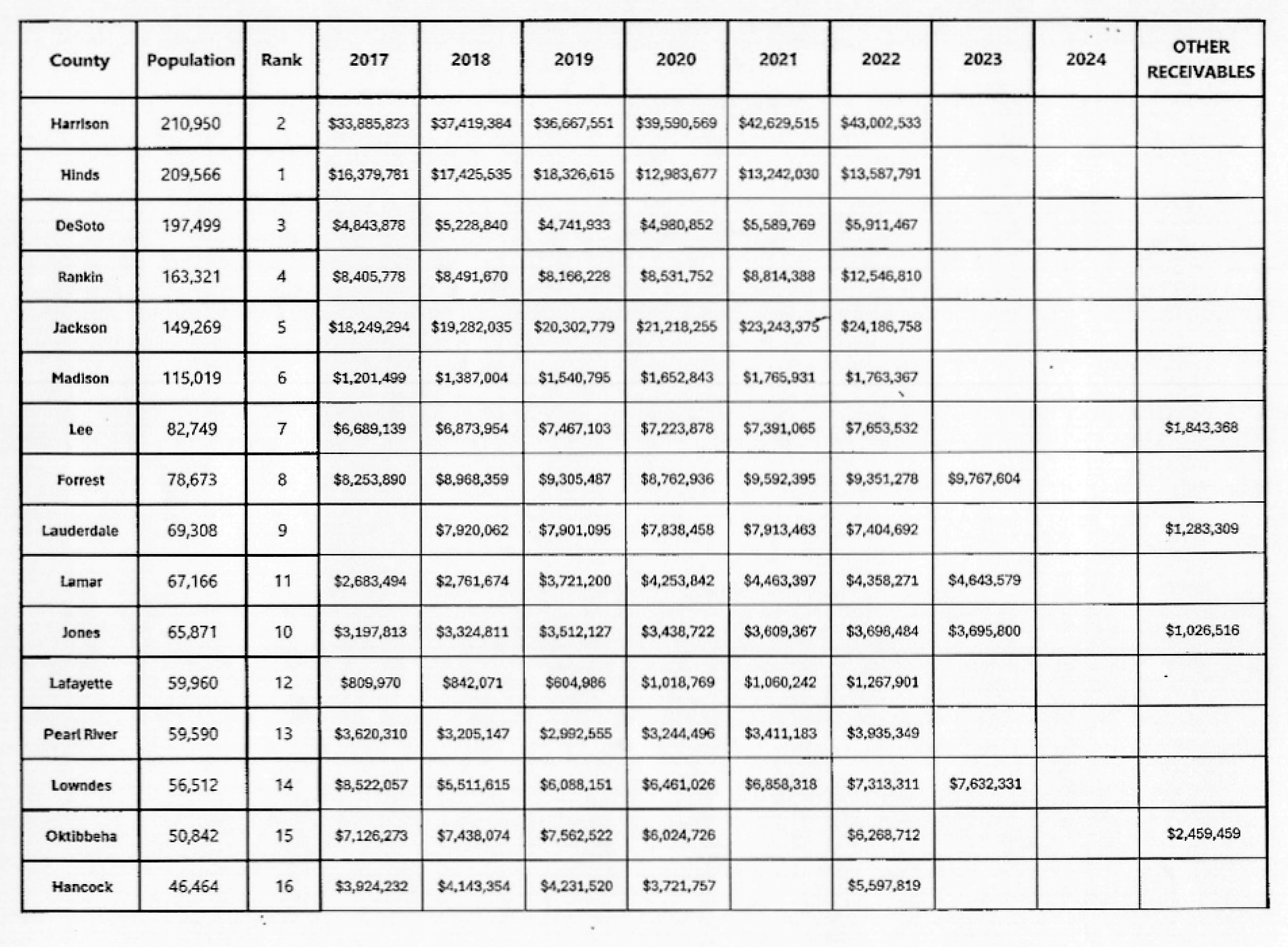
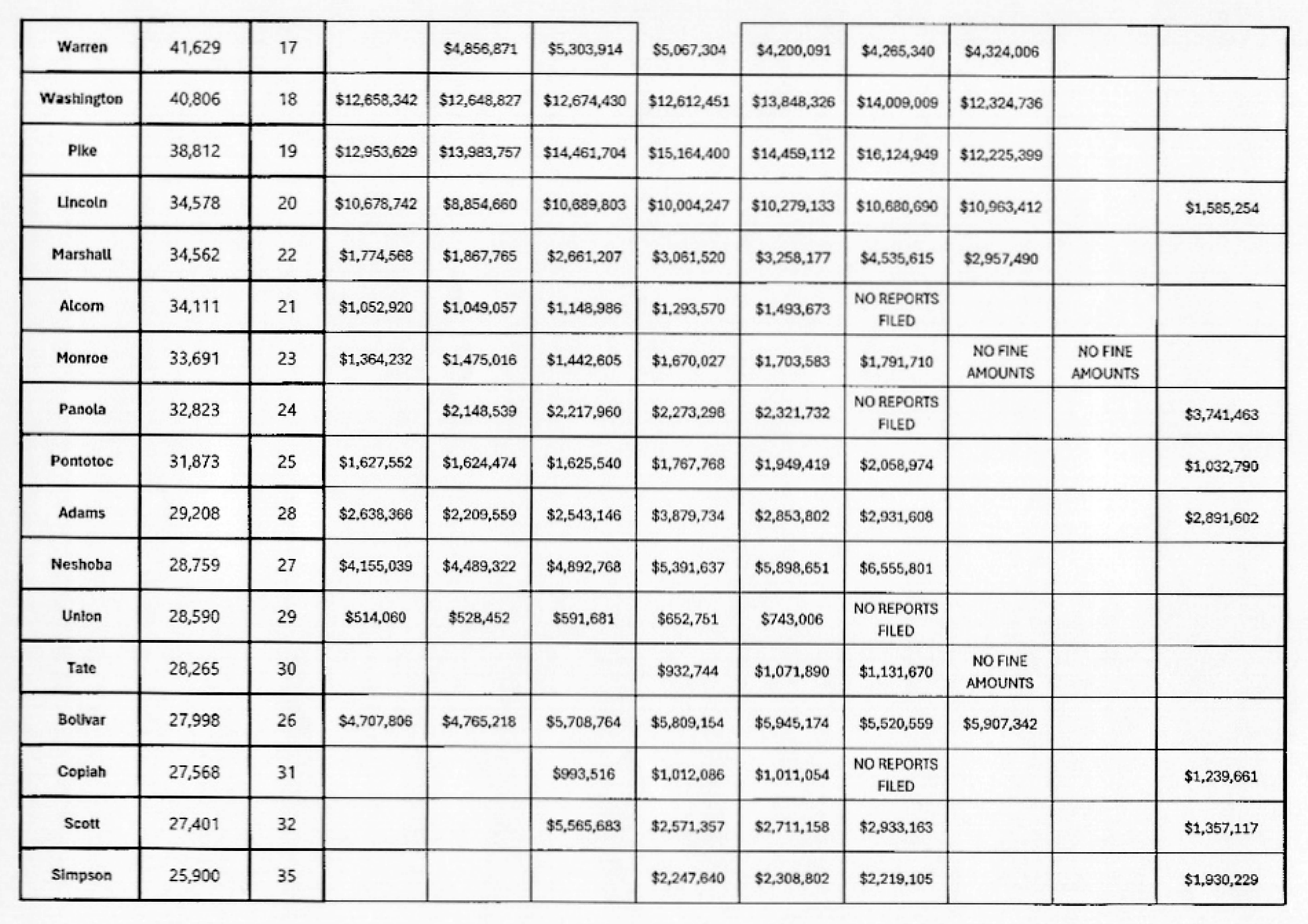
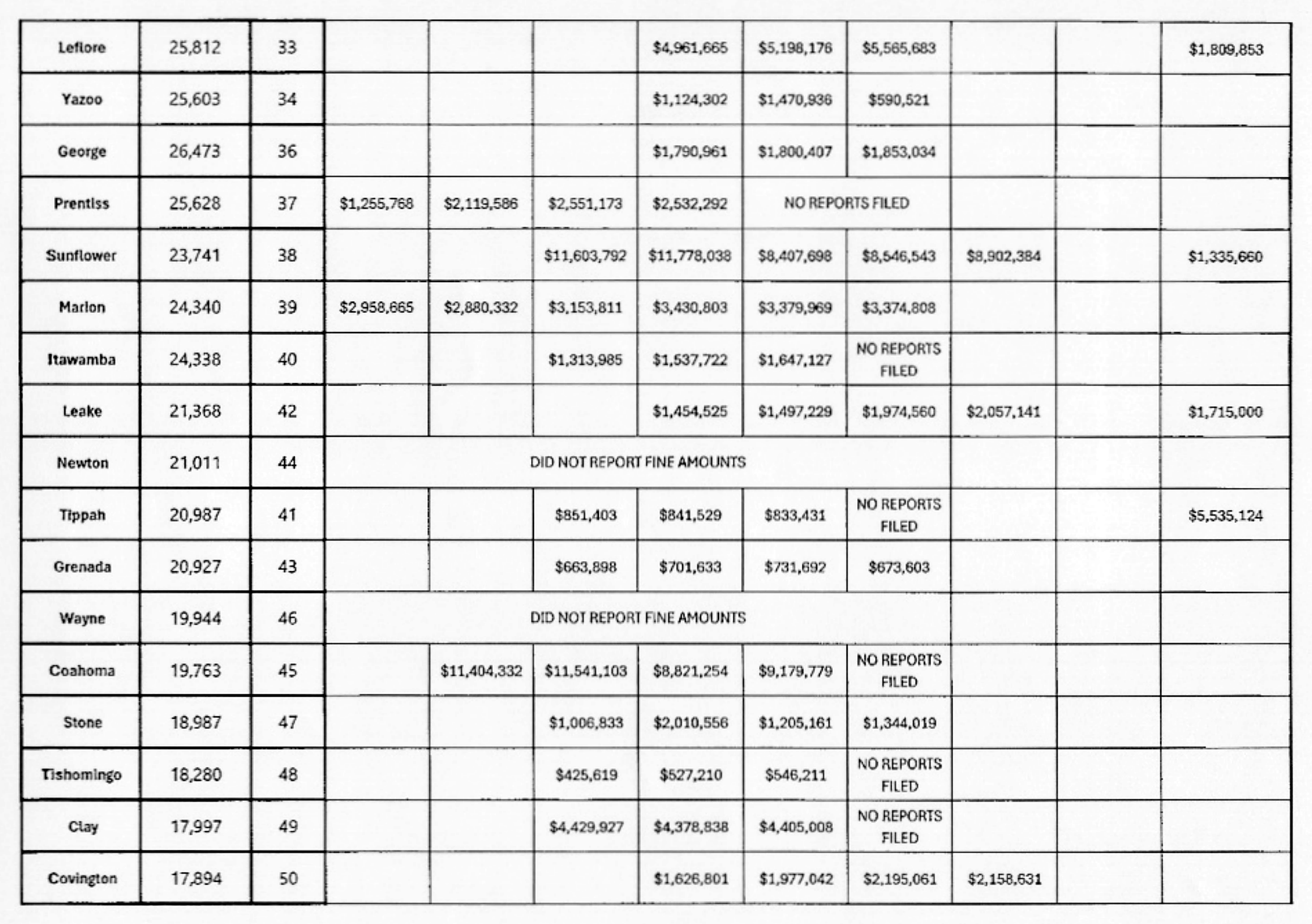
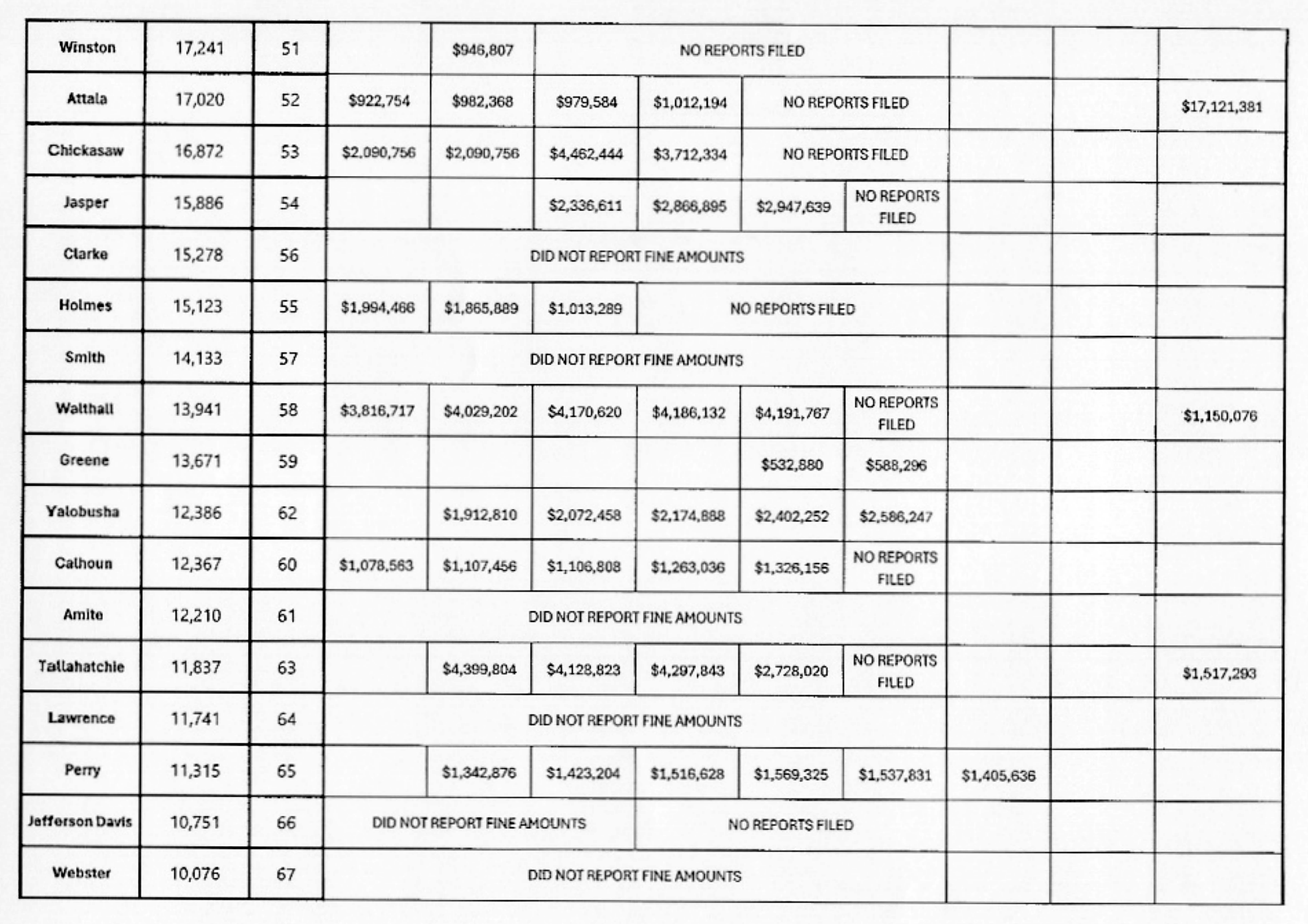
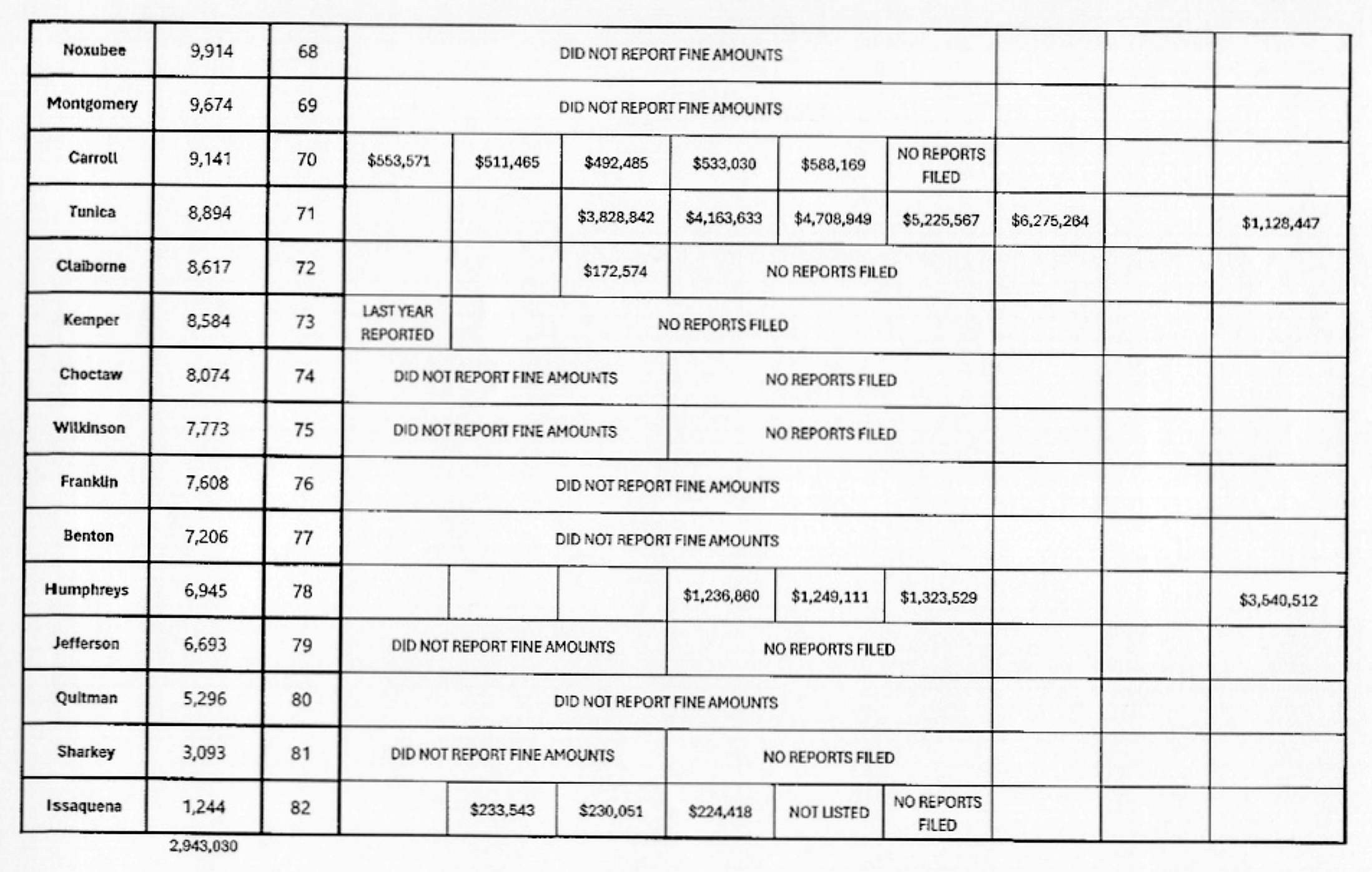
Mississippi has an enormous problem collecting criminal fines and court costs.
Changes beginning in 2017 substantially altered the tools available to courts for dealing with unpaid fines and fees. In 2019, House Bill 1352 further changed Mississippi law by eliminating driver's-license suspensions for unpaid fines and fees and certain traffic-related failures to respond to court. By 2025, reported uncollected fines had reached more than $315.6 million statewide, based on reporting from only about 78 percent of Mississippi counties. County records show millions of dollars in outstanding receivables while numerous jurisdictions either did not report or did not provide usable fine totals.
That is a legitimate problem for Mississippi courts, counties, municipalities, and taxpayers.
But it creates another serious question.
If collecting fines after conviction has become increasingly difficult, are some courts beginning to rely more heavily on cash before conviction?
The existence of hundreds of millions of dollars in uncollected fines does not establish why any particular court orders cash bail. But the financial reality cannot be ignored when defendants are simultaneously entering jail with default misdemeanor bonds far above statewide recommendations and others are being required to post cash while the written-bond option is set at zero.
Bail is a pretrial release mechanism. Its purposes are to secure the defendant's appearance and address legitimate public-safety concerns. Bail is not a sentence. It is not a fine. And it should never become a substitute collection system for money that might eventually be owed if the defendant is convicted.
A person arrested for DUI may ultimately be found guilty. The person may plead guilty and owe every dollar of the fine imposed by the court.
But none of that has happened at booking.
At that moment, the person is accused.
There is a tremendous difference between the government saying, “You must provide reasonable assurance that you will return to court,” and the government saying, “Give us thousands of dollars before you can leave jail.”
Courts need the ability to deal with defendants who repeatedly fail to appear, present a genuine danger, or have individual circumstances that justify conditions outside the normal range. Rule 8 gives judges that discretion. But replacing individualized judgment with default punishment, denying access to sufficient sureties, and allowing pretrial cash bail to become a substitute for post-conviction collection reverses the entire order of the criminal justice system.
The State must prove the case first.
Punishment comes afterward.
Because when the financial punishment begins at the jail door — before the defendant has entered a plea, before the evidence has been heard, and sometimes before the first court date has even been set — the presumption of innocence begins to mean very little.
In Mississippi, being arrested is not supposed to mean being found guilty.
Our bail practices should reflect that.
Does this count right to you? Who is watching the police and their procedures?
3 On Your Side Investigates: Unreasonable Suspicion
Body camera video, K9 expert raise questions in Reservoir traffic stop lawsuit
RANKIN COUNTY, Miss. (WLBT) - A traffic stop that began with an expired tag on a California license plate ended with a Jackson woman claiming the officers involved violated her civil rights, damaging her vehicle in a fruitless search for drugs after her pleas for an attorney.
Officers with the Reservoir Police Department and a K9 handler from the Flowood Police Department searched for nearly an hour while Keely Sexton sat handcuffed, accused of trafficking drugs.
No drugs were found. She is now suing the officers involved and their respective departments.
Body camera video obtained by 3 On Your Side shows the April 6, 2025, stop on Spillway Road, where Reservoir Police Officer Brady Chamblee pulled over Sexton, a Jackson resident who had spent the day shopping and getting her nails done.
 C.J. LeMaster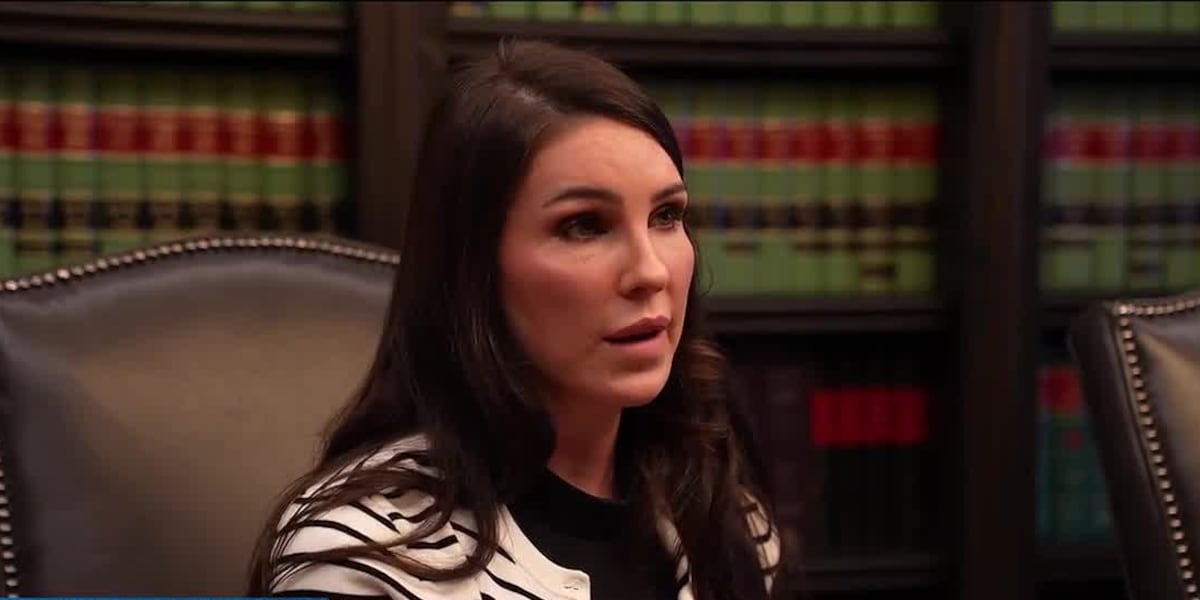
About the Author
Mike Morrison is the 2026 PBUS National Bail Agent of the Year, President of the Mississippi Bail Agents Association, and a nationally recognized bail educator, speaker, and criminal justice commentator. With more than 35 years of hands-on experience as a licensed Professional Bail Agent and owner of Mike Morrison Bail Bonding Company in Hattiesburg, Mississippi, he brings a practical, real-world perspective to discussions involving bail, criminal justice, constitutional rights, public safety, government accountability, technology, and public policy.
Morrison is recognized as a bail trainer by the Mississippi Judicial College and has been invited to present before judges, justice court clerks, prosecutors, bail professionals, and other criminal justice stakeholders, including as a guest speaker for the Mississippi Attorney General’s Office. He also leads professional education and ethics programs for bail agents across the country through the Master Class Bail Agent Series and other national training initiatives.
He has published nearly 200 articles examining the institutions, policies, and decisions that affect working Americans. His writing is grounded in decades spent inside courtrooms, jails, communities, and the criminal justice system, and his commentary has reached more than one million views across social media in 2026.
Independent, plain-spoken, and focused on accountability, Morrison writes and speaks about the intersection of government, liberty, public safety, professional responsibility, and the real-world consequences of public policy in Mississippi and across the nation.
© 2026 Mike Morrison. All rights reserved.